











Introduction
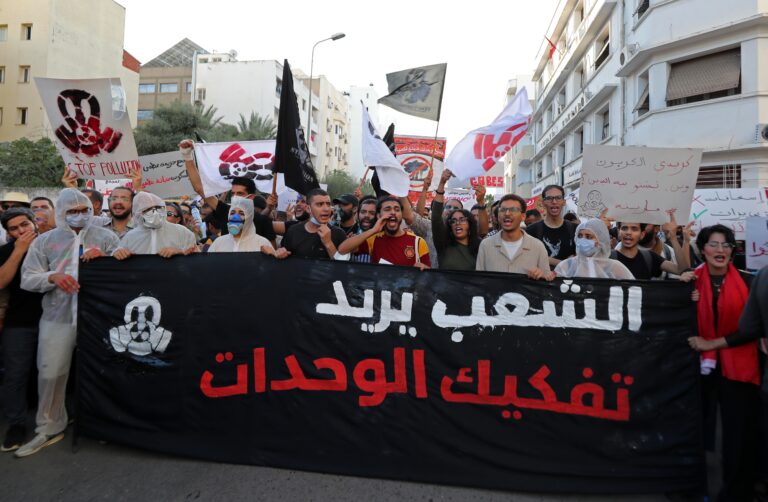
Iraq is facing an active environmental–historical crisis that, over the past two decades, has turned into an existential challenge and a “social problem” subject to ongoing contention. This contention takes place mostly peacefully, and at times violently, between affected local environments and communities that express their grievances through demands, advocacy, support, and protest on the one hand, and expanding authoritarian policies and measures on the other. These policies are driven toward curbing popular grievances, suppressing and neutralizing demands, with the aim of preventing them from developing into an influential “social movement” that could provoke further popular discontent, potentially threatening the stability and survival of the political system.
The basic approach to understanding the nature of the contention and how it is managed requires a general description of the crisis and its effects on those affected, as they are the main stakeholders who possess the legitimacy to make claims, advocate, and protest (claims-makers). Environmental public policies are supposed to be designed on the basis of their demands for redressing grievances, rather than formulating dominant narratives that disregard the crisis and the scale of suffering and place their legitimate struggle in a zone of contention with the state and governance structures. Authoritarian narratives work to portray the mobilization of those affected as “evil” groups seeking to undermine civil peace and strike at national stability, while an analysis of the facts associated with the various forms of the crisis shows that the state, the government, or authoritarian regime structures often recognize these demands as “security threats.” Such a classification leads them to activate coercive interventions against the affected, instead of dealing with their demands as an expression of the deterioration in the quality of services, life, and living conditions. In other words, this constitutes a conditional recognition grounded in a logic of confinement, aimed at justifying the dynamics of repression rather than serving as a starting point for formulating effective remedies. Authoritarian structures generally respond negatively to problems resulting from environmental imbalance, and may at times resort to proposing stopgap solutions for the sake of “calming” the situation, but their response is invariably surrounded by containment measures that entail further “strangulation and restriction.”1Emmanuel Henry, Amiante. Un scandale improbable: sociologie d’un problème public, Presses universitaires de Rennes, Rennes, 2007, available at https://books.openedition.org/pur/12719
This paper proposes an interactive reading and analytical discussion, within the framework of the sociology of social problems, of the conflict over framing “environmental narratives” between affected local communities and the multiple authoritarian structures in Iraq, whether the central government, local governments, interest groups within the system linked to regional actors, or oil industry companies whose activities contribute to the exacerbation of the environmental crisis. The environmental problem and the contention over narratives and their framing appear as a highly intertwined and complex fabric, given other concurrent factors that give the “conflict” dimensions greater than merely a local “social grievance crisis” that would require spaces for negotiation with the authorities, or that would place the blame solely on the practices of regional actors such as the upstream countries of Iran and Turkey. Accordingly, the paper proposes a normative definition of the problem as an entry point for presenting the facts that indicate authoritarian framing and the local counter-responses to it. The study will do so by highlighting three main manifestations:
- First: Forms of contention between the public sphere and authoritarian structures.
- Second: The exchange of roles of accusation and responsibility, from the general central framework to more localized and marginal spaces.
- Third: An analysis of the local community’s capacities to produce differentiated representations of environmental mobilization in order to confront authoritarian restrictive practices.
Based on this, the narration and analysis of facts constitute the function and the basic tool for understanding the methodological framing of this paper.
Endnotes
| ↑1 | Emmanuel Henry, Amiante. Un scandale improbable: sociologie d’un problème public, Presses universitaires de Rennes, Rennes, 2007, available at https://books.openedition.org/pur/12719 |
|---|