



Introduction
Since the chemical complex was established in 1972,1The Gabès chemical complex, part of the Tunisian Chemical Group (GCT), is a major industrial hub dedicated to phosphate processing (phosphoric acid and fertilizers). Established in the 1970s near the city, the oasis, and the coastline, it brings together production units, storage, and disposal facilities, including phosphogypsum, which has long been dumped into the sea, with documented effects on ecosystems (degradation of seagrass beds, sediment pollution, and heavy metals). The complex occupies an ambivalent position: it is the largest local employer, which has created economic dependence, and, at the same time, it is at the center of ongoing protests linked to chronic air and marine pollution. Gabès has become one of the most emblematic hotspots for ecological conflict in Tunisia. The gradual degradation of oases, atmospheric and marine pollution, and the increase in respiratory diseases and cancers have created a feeling among parts of the population that they are living in a territory sacrificed in the name of development, imposed from above. This situation fuels a sense of environmental injustice and social vulnerability, where health, economic, territorial, and symbolic issues intersect.
The collective asphyxiation episodes in the fall of 2025, affecting students in particular, are part of this prolonged crisis that had ruptured: an event that makes visible what was already felt, transforming chronic risk into public conflict. It is this sequence that the Stop Pollution-Gabès2Initiated by young local activists, Stop Pollution-Gabès is a citizen campaign launched in Gabès on 5 June 2012 (World Environment Day), and structured as a horizontal collective. It mobilizes against industrial nuisances and pollution linked to the region’s chemical complex, claiming the right to life and a healthy environment. campaign spreads, at the crossroads between citizen mobilization, counter-discourse production, and questioning the chemical complex’s dominance.
This analytical and critical paper aims to examine the impact of this campaign on both the local ecological conflict and Tunisian protest culture. It analyzes the forms of action, framing, actors, and registers of politicization that come into play, at the national context, marked by narrowing the political field and reshaping ways to protest.
The research questions can be formulated as follows:
- How does the Stop Pollution-Gabès campaign transform an episode of acute pollution into a structured socio-ecological conflict?
- How does it frame the problem, designate adversaries, and articulate solution horizons and repertoires of action?
- How is this campaign redefining forms of politicization in post-2011 Tunisia, challenging not so much the government but a model for development, and demanding breathable air and a cancer-free life as a new political language?
Methodology
This article draws on scientific, media, and activist sources. On the one hand, it draws on existing literature on the ecological crisis in Gabès in order to situate the 2025 “event” empirically and historically. On the other, a qualitative content analysis based on a digital corpus consisting of 59 publications and screenshots from the Stop Pollution-Gabès Facebook page (September–November 2025 sequence, partial corpus), and 22 LinkedIn screenshots from one of the movement’s leaders. A sub-corpus supplements institutional and media statements (speeches, press releases, trade union appeals, and disclosures).
This body was coded using contributions from social movements – diagnostic/prognostic framing, conflict politics, WUNC (Worthiness, Unity, Numbers, Commitment) displays, action repertoires, etc. – and the political sociology of social movement campaigns, in order to reconstruct the mobilization sequence, identify dominant actors and frameworks, and understand how a series of asphyxiation episodes was transformed into a structured socio-ecological conflict.
Before the Event: What Research Says about the Ecological Situation in Gabès
Long before the 2025 mobilizations, scientific literature had already clearly established the severity and persistence of the environmental crisis in Gabès. Saïed and Lahmar show that the establishment of the chemical complex gradually transformed the oasis and its coastline into an industrial area with high levels of air pollution, leading to a documented increase in respiratory and dermatological diseases, as well as a marked decline in oasis agriculture, fishing, and tourism.3Saoussen Saïed and Karim Lahmar, “L’Aménagement Écologique au Service de l’Environnement: Cas de la Ville de Gabès et de M’Torrech (Sud Est Tunisien)”, European Scientific Journal 17, no. 14 (2021) pp. 300–311, https://doi.org/10.19044/esj.2021.v17n14p300 At the marine level, Rabaoui et al. demonstrate – based on analyzing four species of mollusks collected from the Gulf of Gabès – high rates of heavy metal accumulation (particularly cadmium, lead, and mercury) correlated with phosphogypsum discharges into the sea – associated with the degradation of Posidonia oceanica seagrass beds, a key marine ecosystem.4Lotfi Rabaoui et al., “Assessment of Heavy Metals Pollution in the Gulf of Gabès (Tunisia) using Four Mollusk Species”, Mediterranean Marine Science 15, no. 1 (2014) pp. 45–58, https://doi.org/10.12681/mms.504 These discharges are estimated at around 10 million tons of phosphogypsum dumped each year in the Gulf of Gabès, which highlights the scale of chronic pollution that shapes the ecosystem and local socio-ecological conflict.5Abou Sarra, “Pollution in Gabès: Between Impossible Justice and Citizen Anger”, Webmanagercenter, 29 October 2025, https://tinyurl.com/ytxpv66y At the same time, Atoui and Agoubi reveal that 41% of the South Gabès aquifer is at high to very high risk of pollution due to a combination of industrial pressure, overexploitation of groundwater, and a lack of hydrogeological protection.6Mounir Atoui and Belgacem Agoubi, “Assessment of Groundwater Vulnerability and Pollution Risk using AVI, SPI, and RGPI Indexes: Applied to Southern Gabès Aquifer System, Tunisia.” Environmental Science and Pollution Research 29 (2022) pp. 50881–50894, https://doi.org/10.1007/s11356-022-19309-5
Through a questionnaire completed by 500 people and interviews, Khlifi analyzes social representations of the risks associated with air pollution in Gabès within the framework of Beck’s risk society theory.7Kamel B. Abdesslem Khlifi, “Social Representations of Air Pollution Risks in Bouchemma and El-Zarat (Gabès): A Sociological Study within the Framework of Risk Society Theory”, Journal Index of Exploratory Studies 19, no. 3 (2025), https://democraticac.de/?p=106359 [Khlifi, “Social Representations of Air Pollution Risks”] The study highlights a strong awareness of health and environmental issues, a sense of environmental injustice, and ambivalent responses combining resignation, symbolic resistance, and expectations of environmental justice.8Khlifi, “Social Representations of Air Pollution Risks”. The quantitative results indicate marked spatial disparities: in Bouchemma, 27.3% of respondents reported cases of asthma (compared to 10.5% in El-Zarat). During the sulfur dioxide (SO₂) peak on 6 May 2017 – an Agence Nationale de Protection de l’Environnement (ANPE) station mobile recording in Chentech, 4 km from Bouchemma– fifty percent of those surveyed in the exposed area reported respiratory irritation, 40% of whom reported respiratory problems or asphyxiation episodes (including five schoolchildren), and 8.3% reported needing medical attention (17 hospitalized).9Khlifi, “Social Representations of Air Pollution Risks”. The author concludes that there is a need for participatory environmental governance, risk-sensitive urban planning, and the integration of lay knowledge, understood as knowledge gained from residents’ daily exposures (perceptions of odors, asphyxiation episodes, pollution patterns, avoidance routes, and health effects) to reduce socio-spatial inequalities.10Khlifi, “Social Representations of Air Pollution Risks”.
In his analysis of post-2011 environmental mobilizations, Robert shows that, in the case of Gabès, public authorities have long refused to recognize the extent of industrial pollution linked to phosphate processing activities, carried out mainly by the Tunisian Chemical Group (GCT).11Diane Robert, “Reshaping of Local Mobilization against Industrial Pollution in Post-2011 Tunisia: Countering Pollution and Territorial Injustices?” Universitas 1, no. 2 (2025) pp. 423–452, https://hal.science/hal-04946868v1 She points out that during the period studied, the lack of systematic epidemiological studies and consolidated regional health databases made it difficult to measure the cumulative and comparable incidence of diseases attributable to industrial emissions in Gabès. However, since 2023-2024, medical research has begun to document, based on hospital data, correlations between exposure to certain air pollutants and respiratory indicators.12Souha Abdenneji, Sabrina Majdoub Fehri and Hamida Kwass, “Pollution dans la Région de Gabès: Corrélation avec l’Évolution des Pneumonies Communautaires Aiguës”, Revue des Maladies Respiratoires Actualités 16, no. 1 (2024) pp. 211–212, https://doi.org/10.1016/j.rmra.2023.11.435 [Abdenneji, Fehri and Kwass, “Pollution dans la Région de Gabès”] This research is still partial, hospital-centered, and limited to specific time frames, and does not (at this stage) constitute a continuous regional epidemiological database that includes the entire population, which allows for robust comparisons over time and between areas.13Abdenneji, Fehri and Kwass, “Pollution dans la Région de Gabès”. Faced with local protests, sit-ins, production blockades, and strikes, the GCT, with the support of international donors, has implemented a policy of “ecological modernization”, combining public communication, meetings with civil society, and environmental projects presented as reconciliatory.14Abdenneji, Fehri and Kwass, “Pollution dans la Région de Gabès”. Robert shows, however, that these measures have had limited effects and have not addressed the structural causes of pollution.15Abdenneji, Fehri and Kwass, “Pollution dans la Région de Gabès”. At the same time, the state and companies have resorted to compensatory measures, notably through the Sociétés d’Environnement, de Plantation et de Jardinage (SEPJ), which offer jobs or material aid in order to defuse blockages, at the cost of increasing the local economy’s dependence on industry. Finally, plans to relocate phosphate processing units to peripheral areas, including Menzel Habib, are part of a more general trend of removing polluting facilities from urban centers and relocating them to peripheral areas. These relocations can then be interpreted, in Robert’s analysis,16Diane Robert, “’La Pollution, Dégage!’ Une Approche Géographique des Mobilisations Liées aux Nuisances Industrielles dans la Tunisie Post-2011”, Carnets de Géographes 18 (2024), https://doi.org/10.4000/12suz as “spatial fixes” in Harvey’s sense: precarious spatial arrangements aimed at temporarily overcoming the contradictions highlighted by environmental conflicts, but which come at the cost of the contamination of new territories and are likely to produce, in turn, new protests.17David Harvey, “Globalization and the ‘Spatial Fix’”, Geographische Revue: Zeitschrift für Literatur und Diskussion 3, no. 2 (2001) pp. 23–30, https://www.geographische-revue.de/archiv/gr2-01.pdf
Thus, long before the explosion of protest, these studies converge to establish that the ecological crisis in Gabès is structural, documented, and long-lasting, affecting living organisms, human health, and natural resources, in a context where identified, technical solutions remain largely or entirely unimplemented.
The Triggering Event: A Fork in the Road
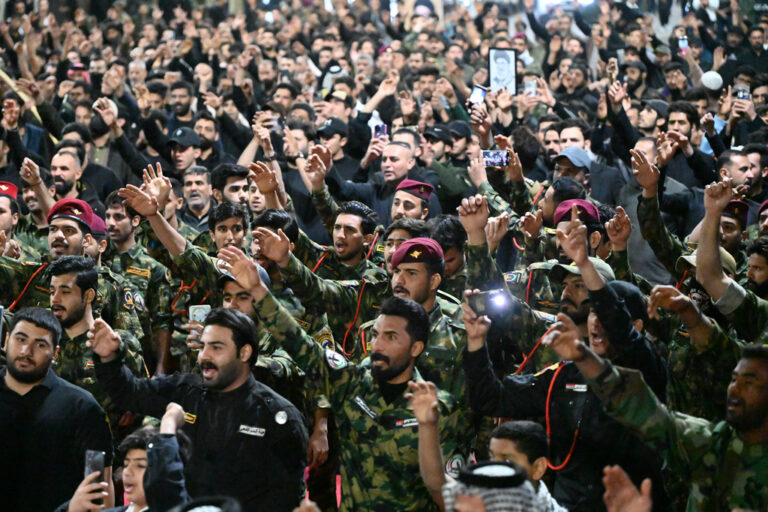
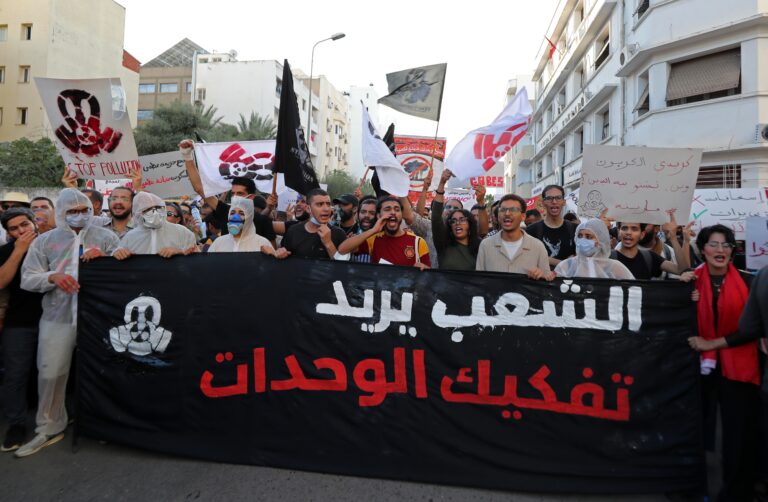
Several hundred people gathered on Friday 10 October 2025 to protest the phosphate processing plant in Gabès. This mobilization follows a major health crisis. Since 9 September 2025, more than 180 people had been hospitalized as a result of gas poisoning, including dozens of schoolchildren.18Driss Rejichi, “En Tunisie, la Colère Monte après de Nouvelles Intoxications par le Groupe Chimique Tunisien à Gabès”, Le Monde, 13 October 2025, https://tinyurl.com/muncftav The protesters accuse the company of dumping its waste into the sea and into the open air. “The people want the chemical group dismantled”, “We want to live”, “Gabès is a victim of pollution and government injustice”, chanted Stop Pollution protesters. Among these incidents, on 9 September, about 20 people were hospitalized for respiratory problems linked to fumes from the same factory.19Tunisie Focus, “Gabès: Manifestations et Grognes Sociales Contre le Complexe Chimique après des Cas d’Asphyxie”, 11 October 2025, https://tinyurl.com/4vx6t9jp
In the wake of the first demonstrations and the rapid rise in anger in the fall of 2025, the events in Gabès were accompanied by a crackdown that confirmed that the situation had shifted from a health “incident” to a structured public conflict. The press reported security interventions, waves of arrests targeting demonstrators, including minors, and a political-security response to the movement, at the very moment when mobilization was expanding (general strike, union support, increasing calls for action) and criticism of the chemical-industrial model became more direct.20Tarek Amara, “Once an Idyll, Tunisian Protest Hotspot Gabès Now an Environmental ‘Nightmare’”, Reuters, 21 October 2025, https://tinyurl.com/2ddmd2k3
By autumn 2025, a causal link between widespread unrest and increased state coercion reinforced the interpretation as a turning point: the episodic asphyxiations not only produced outrage, they also reconfigured the balance of power, crystallized opposing camps, and established Stop Pollution-Gabès as a lasting dynamic of socio-ecological protest.21Monia Ben Hamadi, “Surge in Tunisia Poisoning Cases Shakes Kaïs Saïed’s Presidency”, Le Monde, 22 October 2025, https://tinyurl.com/bdfdabvs [Hamadi, “Surge in Tunisia Poisoning Cases”] A fortiori, from a sociological perspective, this episode can be understood as a bifurcation event, in the Bidart and Grossetti sense: “a moment of rupture that reconfigures interpretations of reality, redistributes possibilities, and opens up new trajectories for collective action, without its effects being mechanical or entirely predictable.”22Marc Bessin, Claire Bidart and Michel Grossetti, “Les Bifurcations, un État de la Question en Sociologie”, in Bifurcations: Les Sciences Sociales Face aux Ruptures et à l’Événement, La Découverte, pp. 23–35, https://doi.org/10.3917/dec.bessi.2009.01.0023
When the Presidential Reaction Opens Pandora’s Box
The first presidential speech, delivered on 30 September 2025, came after the asphyxiation episode, adopting an alarmist tone that resembled a denunciation of ecocide: the president described the situation as a “crime” and referred to a veritable “assassination of the environment”, evoking the idea of a region that has been sustainably damaged by an industrial model imposed for decades. Three weeks later, in his second speech on 21 October 2025, he shifted his framing significantly: the crisis was no longer presented as the result of a structural economic choice, but as the result of the actions of “corrupt individuals” who must be isolated and “unmasked”. 23Raouf Ben Hédi, “Face à la Crise de Gabès, Kaïs Saïed Dénonce ‘les Corrompus’ et Promet des Résultats”, Business News, 22 October 202, https://tinyurl.com/mptbmxyh This second speech came the day after a regional general strike was called by the Tunisian General Labor Union (UGTT) and a show of force by demonstrators on the streets of Gabès, which wrested control from the official framing of the crisis.24Tarek Amara, “General Strike, Protests Paralyse Tunisia’s Gabès over Pollution Crisis”, Reuters, 21 October 2025, https://tinyurl.com/3dubs5pd
This shift is significant: the first discourse recognizes collective and structural injustice, while the second repoliticizes the situation in moral terms, pitting an “honest people” against actors accused of manipulating ecological suffering. It allows the regime to validate the outrage while neutralizing its potential for protest by shifting it from the political-ecological arena to a moral narrative, thereby avoiding any questioning of the industrial model itself. It is now no longer just an internal “shift” within the same framework, but a clear inflection that reconfigures the political reading of the crisis. The recognition of historical injustice, which began on 30 September, gives way to suspicion of the protests at the very moment when they demonstrate their capacity for collective paralysis (general strike, show of force in public spaces). This moral reclassification also has another function: it allows the effects of pollution to be denounced without actually opening up the discussion of the underlying economic architecture that produced it. In other words, condemnation of the disaster can coexist with the relaunch of a national recovery agenda based on phosphate, significantly increasing its production by 2030. This coexistence of a language of protecting life and a horizon of extractive growth exacerbates the conflict. It makes the gap between the president’s words and the state’s material trajectory, in terms of industrial choices, clear to the actors involved.25Hamadi, “Surge in Tunisia Poisoning Cases”.
Above all, this second speech acts as a veritable Pandora’s box in the relationship between the movement and the presidency. Until now, some of the actors in Gabès could still hope for a positive reaction from Kaïs Saïed who, prior to his election, was perceived as the one who had denounced the ecological injustice suffered by the region. This expectation of a presidential intervention is also part of a broader political configuration, in which the head of state is portrayed as an arbitrator above the administration and as a “repairer” of the wrongs caused by the elites and the apparatus.26Malek Lakhal, “Tunisia: The Nation and Its Traitors”, Arab Reform Initiative, 12 December 2023, https://tinyurl.com/3rknsr9j In this context, some of the social anger tends to be expressed less as a call for negotiable public policies, rather as a request to the president to “decide”, “restore justice”, and “put an end to abuses”. This fosters both a policy of waiting and a personalization of solutions. This is precisely why, in the case of Gabès, the shift is symbolically costly: when the presidency ceases to appear as a possible recourse and begins to disqualify the protest, the object of the conflict is reconfigured, and the target moves closer to the center of power. By choosing to implicitly criminalize the protest – talking about manipulation, troublemakers, and “corrupt” individuals lurking behind popular anger – the president is breaking this symbolic contract. The man who presented himself as the embodiment of the “will of the people” now appears, in the eyes of many, as the representative of a state that continues to suffocate an entire region in the name of industrial profitability.
In the days that followed, this moral stance did not remain mere rhetoric: it was accompanied by a visible tightening of security measures. The October protests were not limited to “declarative” marches: there were also attempts to access the chemical company’s site, brief occupations, and escalate confrontation around a protected industrial area,27TV5MONDE and AFP, “Tunisie: Manifestations contre une Usine dans le Sud après des Cas d’Asphyxie”, 10 October 2025, https://tinyurl.com/bdhwk9kb; Driss Rejichi, “Tunisie: Autour de l’Usine de Phosphates de Gabès, le Nombre d’intoxications Explose et la Colère Enfle”, 16 October 2025, https://tinyurl.com/26cjy4f2 which contributed to the protests being reclassified as a “disorder” to be contained. In this context, the arrests and prosecutions reported by several media outlets28Jeune Afrique and AFP, “En Tunisie, des Dizaines d’Arrestations à Gabès après des Manifestations Anti-Pollution”, Jeune Afrique, 19 October 2025, https://tinyurl.com/un46eejy; International Federation for Human Rights, “Tunisia: Crackdown on Peaceful Protests in Gabès must Stop”, 23 October 2025, https://tinyurl.com/yw8pevuv are not a peripheral detail: they mark the transition from a presidential framework that delegitimizes (manipulates) anger to a policy of concrete deterrence, which redefines the protesters not as victims of ecocide, but as actors who pose a threat to public order. This shift contributes to further politicizing mobilization against the president himself; from a potential ally, he is gradually becoming the embodiment of the opposing camp, one who protects the chemical complex and, through his choices and words, perpetuates the logic that is slowly killing Gabès.
Campaign, Protest Movement, and Social Movement: The Specificity of Gabès
A social movement is defined as a form of organized collective action aimed at transforming or defending a given social order.29Érik Neveu, Sociologie des Mouvements Sociaux, 7th ed., La Découverte, 2019. [Neveu, Sociologie des Mouvements Sociaux] Della Porta conceives of it as a network of informal actors and organizations, linked by shared values, a collective identity, and practices of solidarity.30Donatella Della Porta, “Mouvements Sociaux et Violence Politique”, in Les Violences Politiques en Europe: Un État les Lieux, Xavier Crettiez and Laurent Mucchielli (eds.), La Découverte, 2010, pp. 271–291, https://doi.org/10.3917/dec.crett.2010.01.0271 [Della Porta, “Mouvements Sociaux et Violence Politique”]
In light of sociological theories of social movements, the ecological mobilization in Gabès has all the characteristics of a structured social movement. It is based on a network of heterogeneous actors linked by a collective ecological identity, ranging from various forms of collective action, notably Stop Pollution-Gabès, to ordinary citizens and local unions.31Della Porta, “Mouvements Sociaux et Violence Politique”. This mobilization also expresses an “intentional acting together”:32Neveu, Sociologie des Mouvements Sociaux. residents identify an adversary (the chemical complex, the state’s industrial policy), define comprehensive demands (right to life, health, the environment, and the city), and deploy a repertoire of collective action (marches, sit-ins, petitions, digital campaigns) consistent with the tradition of campaigns à la Tilly and Tarrow.33Charles Tilly and Sidney Tarrow, “Les Mouvements Sociaux”, in Politique(s) du Conflit: De la Grève à la Révolution, Rachel Bouyssou (trans), Presses de Sciences Po, pp. 193–232, https://tinyurl.com/2vejyvyd [Tilly and Tarrow, Politique(s) du Conflit]
From a Tourainean perspective, the Gabès mobilization is not just a local reaction: it constitutes collective action aimed at structural change.34Alain Touraine, La Société Post-Industrielle: Naissance d’Une Société, Denoël, 1969. [Touriane, La Société Post-Industrielle] It seeks to reconfigure the state’s priorities, shifting from a logic of industrial profitability to a logic of protecting life, and to impose a new relationship between society, the environment, and power, in a context marked by an extroverted extractive model where national and international economic priorities take precedence over the health of local populations. The ecological movement in Gabès is thus part of what Touraine describes as the “challenge to power”, since it contests technocratic domination and the state’s monopoly on the definition of “development”.35Touraine, La Société Post-Industrielle.
This dynamic echoes and extends an empirical-inductive conceptualization of campaigns and social movements based on the Tunisian case.36
Sofiane Jaballah, “‘We Will Not Forgive, We Will Not Wait, Enough’: A Sociological Approach to Youth Movements in Tunisia” [تونس مانيش مسامح، فاش نستناو، باستا‘: مُقاربة سوسيولوجية للحملالت الشبابية في’ ], in Sociology of Collective Action in Tunisia: Multiple Forms of Engagement and Diverse Forms of Protest
[[سوسيولجيا الفعل الجماعي في تونس منذ 14 جانفي 2011, Booklet No. 2, Tunisian Forum for Economic and Social Rights (FTDES), July 2019, https://ftdes.net/rapports/formsofprotests.pdf [Jaballah, “‘We Will Not Forgive’”] The Gabès movement is based on a shared diagnosis (framework): the collective recognition of a problem (structural pollution), the identification of a responsible party (the state, the chemical industry), and the formulation of solutions (transformation of the industrial model, environmental justice).37Robert D. Benford, David A. Snow and Nathalie Miriam, “Processus de Cadrage et Mouvements Sociaux: Présentation et Bilan”, Politix 99, no. 3 (2012), pp. 217–255, https://doi.org/10.3917/pox.099.0217 As in the revolutionary sequence from 17 December 2010 to 14 January 2011,38Jaballah, “‘We Will Not Forgive’”. we see a unification of meaning through common slogans and narratives, a plurality of mobilized classes and social categories, and a strategic horizon that goes beyond simple protest: it aims to transform lifestyle and development.
Finally, in line with the notion of metapolitics,39Alain Badiou, Abrégé de Métapolitique, Seuil, 1998. the Gabès movement is not limited to challenging the state: it proposes an alternative project for society, based on the protection of health, environmental dignity, and territorial justice.
Thus, the ecological mobilization in Gabès appears not only as a fully-fledged social movement, but also as a turning point in Tunisian protest culture, where ecological demands are becoming a new political language.
Stop Pollution-Gabès as a Social Movement Campaign
The Stop Pollution-Gabès campaign is a regional citizen initiative that was officially launched on 5 June 2012 on World Environment Day. This date marks both the crystallization of the movement’s name and its first structured public appearance, in a post-revolutionary context where some of the inhabitants of Gabès believed that the fall of the authoritarian regime would put an end to the environmental damage caused by the chemical complex.40Zoé Vernin, “Gabès: ‘Le Petit Tchernobyl en Tunisie’ Revendique Son Droit à la Vie”, Tunisian Forum for Economic and Social Rights (FTDES), 28 June 2017, https://ftdes.net/fr/2654-2/ [Vernin, “Gabès: ‘Le Petit Tchernobyl en Tunisie’”] The reality of persistent pollution quickly gave rise to a sense of disillusionment, which turned into collective action around a simple and unifying slogan: “N7eb N3ich” (We love to live).41Vernin, “Gabès: ‘Le Petit Tchernobyl en Tunisie’”.
In its early days, Stop Pollution-Gabès was set up as a horizontal, non-partisan campaign, led by young local activists, mainly from associations and human rights circles in Gabès.42Interview with Saber Ammar. From the outset, the organizational choice was clear: to define itself as a citizen collective rather than a coalition of associations or a formal structure, which preserves maximum openness, flexibility, and the ability to bring together diverse social and ideological profiles.43Vernin, “Gabès: ‘Le Petit Tchernobyl en Tunisie’”. This approach aims to prevent the environmental cause from being hijacked by partisan or institutional interests, while maintaining the ability to exert collective pressure on public decision-makers.
The founding core of the movement is characterized by the coexistence of different activist trajectories, which have played a structuring role in its consolidation.44Interview with Saber Ammar. On the one hand, non-politicized environmental activists – such as Nader Chekaya, who was locally involved in associations for protecting the coastline and living environment – brought strong moral legitimacy and solid territorial roots to the campaign.45Interview with Saber Ammar. On the other hand, actors with political experience and more structured activist capital – such as Khaireddine Debaya, who had previously been involved in partisan political and activist forms of action – contributed to the formulation of a coherent discourse, the mastery of public denunciation, and the movement’s ability to endure over time.46Interview with Saber Ammar. This combination of non-partisan environmental commitment and political know-how is one of the key drivers of Stop Pollution-Gabès’ resilience.
From its early years, the campaign has favored a pluralistic repertoire of action: citizen marches, sit-ins, public forums, symbolic central government demonstrations, and local awareness campaigns.47Vernin, “Gabès: ‘Le Petit Tchernobyl en Tunisie’”. An important milestone was reached in May 2013 with the organization of a sit-in in Tunis, in front of the municipal theater, explicitly aimed at bringing the issue of Gabès into the national public arena and breaking cause’s regional isolation.48Vernin, “Gabès: ‘Le Petit Tchernobyl en Tunisie’”. That same year, the 5 June march in Gabès brought together several thousand participants, confirming a broad, social base for mobilization.49Vernin, “Gabès: ‘Le Petit Tchernobyl en Tunisie’”.
Over the years, the annual 5 June march has become a central ritual of the campaign, providing an opportunity for collective visibility, reaffirming demands, and renewing ties between residents, activists, and supporters.50Vernin, “Gabès: ‘Le Petit Tchernobyl en Tunisie’”. Starting in 2015, Stop Pollution-Gabès further expanded its scope by incorporating forms of cultural expression (artistic events, symbolic performances, public debates) in order to reach wider audiences, and strengthening its ecological social and identity dimension.51Vernin, “Gabès: ‘Le Petit Tchernobyl en Tunisie’”. In response to episodes of asphyxiation, Stop Pollution-Gabès established itself in a matter of weeks as one of the most significant examples of what Tilly and Tarrow call a social movement campaign. Far from being a simple emotional reaction to a series of student suffocation incidents or an episode of industrial pollution, the mobilization was structured around a shared diagnosis, an extensive repertoire of action – street marches and rallies, sit-ins, calls for a regional general strike, continuous production of press releases and visuals, circulation of unifying slogans and hashtags, and public appeals to the authorities based on decisions, standards, and counter-expertise – multi-sector alliances, and a strategic framing of the cause,52The Stop Pollution-Gabès digital campaign study is based on a qualitative analysis of all content published on the movement’s official Facebook page between September and November 2025, a period marked by episodes of students suffocating near the chemical complex. This corpus, consisting of several publications (texts, visuals, press releases, calls to action), was analyzed thematically to identify the interpretative frameworks used (pollution diagnosis, designation of those responsible, demands, and alternative horizons). The aim is not only to describe the disseminated messages, but to show how this campaign constructs a collective narrative, legitimizes protest action, and transforms a local health incident into a public cause. making it a sustainable and coherent collective actor in Tunisian conflict politics. According to Tilly and Tarrow, a campaign is a sequence of coordinated and repeated public demands targeting one or more holders of power;53Tilly and Tarrow, Politique(s) du Conflit. this is exactly what happened in Gabès from September 2025 onwards.
The Stop Pollution-Gabès collective first transformed a brutal event – “the asphyxiation of dozens of students and residents” – into a public issue, through a framework that went beyond any technical or accidental explanation of the leak. The campaign’s diagnosis immediately identified the source of the problem: the polluting units of the chemical complex, the state’s failure to control the facilities, and the logic of sacrificial development imposed on the region for decades. By articulating responsibilities, victims, and structural causes in this way, activists shifted the interpretation of the incident to an ecological, health, and political conflict pitting the local population against the industrial apparatus and central government.
In contrast, other “triggering events” in Tunisia have sparked strong public outrage without necessarily becoming a lasting cause due to the lack of an already structured campaign actor. The case of Mezzouna (Sidi Bouzid governorate) in April 2025,54Haythem Dellai, “Behind the Wall Collapse in Mezzouna: Accountability and Reform in Tunisia’s Public Education”, Bawader, Arab Reform Initiative, 4 July 2025, https://tinyurl.com/45e52f9x after the death of three students following the collapse of a school wall, led to demonstrations and public questioning of responsibilities, including at the central level.55Press Release from the President’s Office, “Drame à Mezzouna: Profondément Attristé, le Président Saïed Donne ses Instructions pour Déterminer les Responsabilités”, Republic of Tunisia, 15 April 2025, https://tinyurl.com/53zvsjaf; Al Jazeera, “Protests in Tunisia following the Death of 3 students when a school wall collapses” [احتجاجات في تونس عقب وفاة 3 تلاميذ بانهيار سور مدرسة], 16 April 2025, https://tinyurl.com/3zwk89c7 However, unlike in Gabès – where a campaign such as Stop Pollution has a militant memory, a common language, and a coordinated repertoire – this type of sequence may lose its ability to transform into a prolonged, cumulative, and well-equipped public conflict.
Far from being abstract, this framework has made it possible to considerably broaden and mobilize its social base. Within a few days, there was an impressive increase in numbers: thousands of residents took to the streets, representing a multitude of groups, neighborhoods, and social categories, including entire families, young people, workers, teachers, lawyers, ultras (supporters of local sports teams), and associations. A new type of actor also emerged during this period: the “citizen expert” (notably Saber Ammar)56Saber Ammar is a geo-environmental engineer committed to the ecological cause in Gabès and one of the most visible digital relays of the collective action sequence studied, particularly through his publications on LinkedIn (statements, calls to action, dissemination of technical information, and chronological benchmarks on the mobilization). The information used here comes from a semi-structured interview conducted by the author and a qualitative analysis of the subject’s LinkedIn posts, carried out as part of this research. capable of translating technical elements into mobilizing language, producing accessible counter-expertise, and linking a local cause to broader issues on social media.
In line with WUNC displays analyzed by Tilly and Tarrow, Stop Pollution has demonstrated:
- Worthiness – a fundamental right: the right to breathe,
- Unity – a collective framework: (،”قابس تتحد” “أهالي قابس”),
- Numbers – massive, cross-class, and cross-generational demonstrations,
- Commitment – mobilized local communities, varied repertoire of actions, continuity over time.
What reinforces the campaign’s character, rather than a simple protest, is the coordinated multiplicity of actions: daily press releases, marches, sit-ins, calls for rallies, producing infographics, recalling government decisions of 29 June 2017 – announcing the dismantling of the Gabès chemical complex and replacing it with a yet-to-be implemented alternative project – denouncing ministerial contradictions, calling for general strikes, and publishing real-time alerts when new cases of asphyxiation occur. Digital communication plays a central role: it unifies visual language, sets slogans, and imposes the “memory of the conflict” by chronicling incidents and circulating images of crowds. The aesthetics – gas masks, slogans such as “تنفس ولا موت” (breathe or die) or “نحب نعيش” (we love to live), and red visuals – structure a symbolic space that cement identity.
BOX : When the Trade Union Certifies the Cause: The Role of the UGTT in Gabès
The contribution of the UGTT in Gabès can be clearly seen in the WUNC display grid.57Tilly and Tarrow, Politique(s) du Conflit. The regional union’s support for the Stop Pollution campaign, particularly during the general strike of 21 October 2025,58
Khamis Ben Brik, “General Strike and Angry March in Tunisian Gabès against Chemical Complex”
[إضراب عام ومسيرة غاضبة بقابس التونسية ضد المجمع الكيميائي], Al Jazeera Net, 21 October 2025, https://tinyurl.com/ydseva89 which paralyzed the city and brought together a large crowd around the closure of polluting units, provides the movement with an already established mobilization infrastructure: professional sections, business networks, and local committees. From the point of view of worthiness: the trade union confederation brings dignity and credibility and legitimizes its historical capital – its heritage in the national movement, its role in 14 January, and its ability to appear as the spokesperson for the “working people”. This lends credibility to ecological demands in the eyes of a population long socialized to more traditional repertoires (employment, wages). In terms of unity and numbers, the UGTT is able to transform local outrage into a near-total stoppage of work and commercial activity, giving the protest massive visibility that isolated citizen-groups would not have. Finally, in terms of commitment, the union’s presence signals that the environmental issue is not a mere “angry outburst” but part of a lasting conflict linked to issues of occupational health, social justice, and development models, which Pepicelli analyzes more broadly as the emergence of “eco-resistance” in Tunisia.59Renata Pepicelli, “‘People Want a Clean Environment’: Historical Roots of the Environmental Crisis and the Emergence of Eco-Resistances in Tunisia”, Studi Magrebini 19, no. 1 (2021) pp. 37–62, https://doi.org/10.1163/2590034X-12340039
Politically, this alliance is paradoxical and interesting: Stop Pollution claims to be apolitical in the partisan sense (no reference to parties, no direct challenge to the regime, or the question of democracy), while simultaneously, with UGTT support, engages in politicization in the strong sense of political sociology: challenging public policy (the chemical-industrial model), identifying those responsible, producing counter-expertise, and using the general strike as a means of protest. The issue is no longer to demand work from a chemical complex that is the region’s largest employer, but to challenge the type of development it embodies. In this sense, the UGTT’s contribution shifts the mobilization in Gabès to a struggle that is both environmental and socioeconomic, where the defense of the “right to a healthy environment” becomes a new language of social justice.
This collective action is clearly part of the dynamic of new social movement campaigns in Tunisia. Unlike protests that have historically focused on labor, employment, or socioeconomic marginalization, Stop Pollution breaks with the traditional logic of trade-offs between industrial development and economic security. It explicitly affirms a vision in which life takes precedence over employment, ecological dignity becomes a fundamental right, and a development model based on heavy industry and pollution is rejected. The demand is no longer about access to work but about the rejection of work and growth that kill. This break is decisive: it shifts the ecological protest in Gabès to a category of alternative socio-ecological movements, promoting a vision of society based on environmental justice, public health, and ecological sovereignty.
BOX : From “Manich Msameh” to “Stop Pollution-Gabès”: Two Campaigns, Two Political Horizons
In many ways, Stop Pollution-Gabès differs profoundly from a campaign such as Manich Msameh.60Jaballah, “‘We Will Not Forgive’”. The latter was a defensive social movement campaign, typical of “reactionary” mobilization in the Tilly and Tarrow sense: it arose to prevent a comeback by the old regime through an economic reconciliation law favorable to corrupt elites.61Jaballah, “‘We Will Not Forgive’”. Its objective was targeted, limited, and essentially ad hoc: to block a specific political project without proposing an alternative model of governance.62Jaballah, “‘We Will Not Forgive’”. Its politicization was explicit and classic: the presence of activists, associations, sometimes parties, direct confrontation with institutions, frontal opposition to the presidency and the government, but without a broader programmatic horizon.63Jaballah, “‘We Will Not Forgive’”.
In contrast, Stop Pollution-Gabès is not structured around declared political opposition or partisan institutional confrontation. The movement even displays a form of strategic depoliticization (no parties, no slogans about regime change, and no demands related to employment, even though the chemical group is the largest local employer). However, this “depoliticization” actually serves to repoliticize in a different way: not the regime, but development choices; not institutional democracy, but the right to life, health, and a non-toxic environment. While Manich Msameh sought to prevent a return to the past, Stop Pollution-Gabès promotes a radical transformation project, an alternative socioeconomic model: moving away from polluting productivism as the way forward. Less politicized in form, Stop Pollution is in fact much more political in substance: it does not merely oppose a law or a government, it challenges an entire regime of social production, one that sacrifices residents in the name of industrial profitability.
At the end of this process, what could have remained an emotional and momentary mobilization solidified into a strategic campaign aimed at structural change: dismantling polluting units, independent investigations, political accountability, the right to health, and above all, the emergence of an alternative socioeconomic model compatible with life. Through its actions, Stop Pollution perfectly illustrates what Tilly and Tarrow describe as conflict politics: a structured confrontation between organized citizens and institutional actors over the legitimate definition of the public interest.64Tilly and Tarrow, Politique(s) du Conflit. Gabès, in this trajectory, is not only demanding to breathe: it proposes a different vision of development, based on a social ecology that refuses to sacrifice the population in the name of growth.
Conclusion
The sequence that began in Gabès in the fall of 2025 shows that local mobilizations can no longer be understood solely in terms of old “social protest” patterns for employment or against the high cost of living. By transforming an acute episode of pollution, suffocating students, gas leaks, and health panic into a systematized social movement campaign, Stop Pollution-Gabès reveals a profound restructuring of Tunisian protest culture. The campaign did not arise in a vacuum, nor was it based solely on emotion: it is part of a long history of environmental injustice documented by research, decades of sacrifice imposed in the name of industrialization, and a lasting sense of territorial relegation. It is because this scientific, health, and social reality already exists that the 2025 event can function as a turning point and not merely as a news item.
Analysis has shown that Stop Pollution-Gabès meets the criteria for a social movement campaign as defined by Tilly and Tarrow: continuous public demands, framing the problem coherently, identifying adversaries, wide-ranging actions, multi-sector alliances, and a long-term commitment. The framework is central: diagnosing a toxic development model, identifying those responsible (chemical complex, state choices, institutional denial), formulating an alternative future based on the right to life, health, and a non-lethal environment. This framework makes it possible to move from localized indignation to a shared, cross-class, and cross-generational cause, whose slogans, visuals, and hashtags set the tone (“we want to live”, “Gabès is suffocating”, “dismantle the units”). Far from being “apolitical”, this campaign repoliticizes in a different way: it does not position itself on the classic regime/opposition axis, but challenges the core of public development policies.
The comparison with Manich Msameh sheds light here. Where Manich Msameh had a defensive and ad hoc objective, namely to prevent a reconciliation law perceived as a return of the corrupt elites, Stop Pollution-Gabès promotes a project of radical transformation of a socioeconomic model. Less politicized in appearance (no parties, no slogans about regime change, claims of apoliticism), the movement is in fact more political in content: it not only challenges a piece of legislation or a particular government, but a system of social production that accepts illness and death as natural consequences of growth. This demand is no longer for “more jobs” in a chemical complex – the region’s largest employer – but for the rejection of jobs and wealth that kill. In this sense, Gabès proposes an ecological fork in the road for the protest.
The role of certain collective and individual actors, such as the regional UGTT and civic figures, appears decisive in this transformation. The trade union gives the movement additional legitimacy, organizational capacity, and numerical strength, certifying that the ecological cause is also a matter for social justice and the world of work. For his part, an engineer-activist like Ammar embodies the rise of expert leadership that combines scientific counter-expertise, moral indignation, and digital repertoires, bridging local and transnational environmental justice movements. Together, these resources extend beyond the current crisis, transforming them into a social movement campaign and giving them strategic depth that goes further than mere reaction to an event.
Finally, the trajectory of the relationship between Stop Pollution-Gabès and the presidency of the Republic shows how a socio-ecological conflict can reconfigure the lines of political legitimacy. By opening Pandora’s box with a second speech that implicitly criminalizes mobilization, the president symbolically breaks with a segment of Gabès’ population that still saw him as a possible ally. The man who claimed to be the bearer of the popular will became, for many, the embodiment of a state that persists to suffocate a region in the name of industrial profitability. Politicization thus shifted from a development model to the presidential figure himself, without the movement turning into a classic partisan opposition. This is one of the major contributions of this case study: it shows how, in post-2011 Tunisia, ecological conflict has become a new political language, capable of shifting the boundaries between rulers and ruled, between “the people” and “elites”, between center and periphery.
This article invites us to consider Gabès not as an “ecological exception”, but as a sociopolitical laboratory. It suggests that future central conflicts may no longer focus primarily on sharing institutional power or on the single issue of employment, but on the material possibility of living, breathing, and remaining in place. In other words, the struggle in Gabès is not just about closing down polluting facilities: it stages, in the present, a battle to define what “living with dignity” means in a Tunisia ravaged by climate crisis, territorial inequalities, and tired, inherited development models.
Beyond retrospective analysis, the sequence initiated by Stop Pollution-Gabès invites a cautious but sociologically grounded projection. Through its horizontal structure, its deep territorial roots, and the very nature of its demands, the campaign seems to offer a strategic horizon that is difficult to neutralize with the traditional instruments of power. Demanding the right to breathe, to live without disease and premature death, is neither an ideology nor a religious doctrine; it is a vital, cross-cutting requirement that transcends ordinary political divisions and eludes the usual mechanisms of delegitimization.
With more than a decade of activist experience, accumulated knowledge, memories of broken promises, and proven mobilization practices, Stop Pollution-Gabès is no longer content to react to crises; it anticipates, documents, organizes, and takes a long-term view of the struggle. Faced with a political system that multiplies short-term tactics without offering a credible strategy for moving away from an extractivist model, the campaign is gradually sketching out a possible future: that of a city free from the chemical complex, not as an abstract utopia, but as a trajectory built by collective praxis. In this sense, Gabès is moving slowly, conflictingly but surely toward the reconfiguration of its urban, ecological, and social destiny, making environmental justice no longer a marginal demand but an organizing principle of local political development.
Endnotes
| ↑1 | The Gabès chemical complex, part of the Tunisian Chemical Group (GCT), is a major industrial hub dedicated to phosphate processing (phosphoric acid and fertilizers). Established in the 1970s near the city, the oasis, and the coastline, it brings together production units, storage, and disposal facilities, including phosphogypsum, which has long been dumped into the sea, with documented effects on ecosystems (degradation of seagrass beds, sediment pollution, and heavy metals). The complex occupies an ambivalent position: it is the largest local employer, which has created economic dependence, and, at the same time, it is at the center of ongoing protests linked to chronic air and marine pollution. |
|---|---|
| ↑2 | Initiated by young local activists, Stop Pollution-Gabès is a citizen campaign launched in Gabès on 5 June 2012 (World Environment Day), and structured as a horizontal collective. It mobilizes against industrial nuisances and pollution linked to the region’s chemical complex, claiming the right to life and a healthy environment. |
| ↑3 | Saoussen Saïed and Karim Lahmar, “L’Aménagement Écologique au Service de l’Environnement: Cas de la Ville de Gabès et de M’Torrech (Sud Est Tunisien)”, European Scientific Journal 17, no. 14 (2021) pp. 300–311, https://doi.org/10.19044/esj.2021.v17n14p300 |
| ↑4 | Lotfi Rabaoui et al., “Assessment of Heavy Metals Pollution in the Gulf of Gabès (Tunisia) using Four Mollusk Species”, Mediterranean Marine Science 15, no. 1 (2014) pp. 45–58, https://doi.org/10.12681/mms.504 |
| ↑5 | Abou Sarra, “Pollution in Gabès: Between Impossible Justice and Citizen Anger”, Webmanagercenter, 29 October 2025, https://tinyurl.com/ytxpv66y |
| ↑6 | Mounir Atoui and Belgacem Agoubi, “Assessment of Groundwater Vulnerability and Pollution Risk using AVI, SPI, and RGPI Indexes: Applied to Southern Gabès Aquifer System, Tunisia.” Environmental Science and Pollution Research 29 (2022) pp. 50881–50894, https://doi.org/10.1007/s11356-022-19309-5 |
| ↑7 | Kamel B. Abdesslem Khlifi, “Social Representations of Air Pollution Risks in Bouchemma and El-Zarat (Gabès): A Sociological Study within the Framework of Risk Society Theory”, Journal Index of Exploratory Studies 19, no. 3 (2025), https://democraticac.de/?p=106359 [Khlifi, “Social Representations of Air Pollution Risks”] |
| ↑8 | Khlifi, “Social Representations of Air Pollution Risks”. |
| ↑9 | Khlifi, “Social Representations of Air Pollution Risks”. |
| ↑10 | Khlifi, “Social Representations of Air Pollution Risks”. |
| ↑11 | Diane Robert, “Reshaping of Local Mobilization against Industrial Pollution in Post-2011 Tunisia: Countering Pollution and Territorial Injustices?” Universitas 1, no. 2 (2025) pp. 423–452, https://hal.science/hal-04946868v1 |
| ↑12 | Souha Abdenneji, Sabrina Majdoub Fehri and Hamida Kwass, “Pollution dans la Région de Gabès: Corrélation avec l’Évolution des Pneumonies Communautaires Aiguës”, Revue des Maladies Respiratoires Actualités 16, no. 1 (2024) pp. 211–212, https://doi.org/10.1016/j.rmra.2023.11.435 [Abdenneji, Fehri and Kwass, “Pollution dans la Région de Gabès”] |
| ↑13 | Abdenneji, Fehri and Kwass, “Pollution dans la Région de Gabès”. |
| ↑14 | Abdenneji, Fehri and Kwass, “Pollution dans la Région de Gabès”. |
| ↑15 | Abdenneji, Fehri and Kwass, “Pollution dans la Région de Gabès”. |
| ↑16 | Diane Robert, “’La Pollution, Dégage!’ Une Approche Géographique des Mobilisations Liées aux Nuisances Industrielles dans la Tunisie Post-2011”, Carnets de Géographes 18 (2024), https://doi.org/10.4000/12suz |
| ↑17 | David Harvey, “Globalization and the ‘Spatial Fix’”, Geographische Revue: Zeitschrift für Literatur und Diskussion 3, no. 2 (2001) pp. 23–30, https://www.geographische-revue.de/archiv/gr2-01.pdf |
| ↑18 | Driss Rejichi, “En Tunisie, la Colère Monte après de Nouvelles Intoxications par le Groupe Chimique Tunisien à Gabès”, Le Monde, 13 October 2025, https://tinyurl.com/muncftav |
| ↑19 | Tunisie Focus, “Gabès: Manifestations et Grognes Sociales Contre le Complexe Chimique après des Cas d’Asphyxie”, 11 October 2025, https://tinyurl.com/4vx6t9jp |
| ↑20 | Tarek Amara, “Once an Idyll, Tunisian Protest Hotspot Gabès Now an Environmental ‘Nightmare’”, Reuters, 21 October 2025, https://tinyurl.com/2ddmd2k3 |
| ↑21 | Monia Ben Hamadi, “Surge in Tunisia Poisoning Cases Shakes Kaïs Saïed’s Presidency”, Le Monde, 22 October 2025, https://tinyurl.com/bdfdabvs [Hamadi, “Surge in Tunisia Poisoning Cases”] |
| ↑22 | Marc Bessin, Claire Bidart and Michel Grossetti, “Les Bifurcations, un État de la Question en Sociologie”, in Bifurcations: Les Sciences Sociales Face aux Ruptures et à l’Événement, La Découverte, pp. 23–35, https://doi.org/10.3917/dec.bessi.2009.01.0023 |
| ↑23 | Raouf Ben Hédi, “Face à la Crise de Gabès, Kaïs Saïed Dénonce ‘les Corrompus’ et Promet des Résultats”, Business News, 22 October 202, https://tinyurl.com/mptbmxyh |
| ↑24 | Tarek Amara, “General Strike, Protests Paralyse Tunisia’s Gabès over Pollution Crisis”, Reuters, 21 October 2025, https://tinyurl.com/3dubs5pd |
| ↑25 | Hamadi, “Surge in Tunisia Poisoning Cases”. |
| ↑26 | Malek Lakhal, “Tunisia: The Nation and Its Traitors”, Arab Reform Initiative, 12 December 2023, https://tinyurl.com/3rknsr9j |
| ↑27 | TV5MONDE and AFP, “Tunisie: Manifestations contre une Usine dans le Sud après des Cas d’Asphyxie”, 10 October 2025, https://tinyurl.com/bdhwk9kb; Driss Rejichi, “Tunisie: Autour de l’Usine de Phosphates de Gabès, le Nombre d’intoxications Explose et la Colère Enfle”, 16 October 2025, https://tinyurl.com/26cjy4f2 |
| ↑28 | Jeune Afrique and AFP, “En Tunisie, des Dizaines d’Arrestations à Gabès après des Manifestations Anti-Pollution”, Jeune Afrique, 19 October 2025, https://tinyurl.com/un46eejy; International Federation for Human Rights, “Tunisia: Crackdown on Peaceful Protests in Gabès must Stop”, 23 October 2025, https://tinyurl.com/yw8pevuv |
| ↑29 | Érik Neveu, Sociologie des Mouvements Sociaux, 7th ed., La Découverte, 2019. [Neveu, Sociologie des Mouvements Sociaux] |
| ↑30 | Donatella Della Porta, “Mouvements Sociaux et Violence Politique”, in Les Violences Politiques en Europe: Un État les Lieux, Xavier Crettiez and Laurent Mucchielli (eds.), La Découverte, 2010, pp. 271–291, https://doi.org/10.3917/dec.crett.2010.01.0271 [Della Porta, “Mouvements Sociaux et Violence Politique”] |
| ↑31 | Della Porta, “Mouvements Sociaux et Violence Politique”. |
| ↑32 | Neveu, Sociologie des Mouvements Sociaux. |
| ↑33 | Charles Tilly and Sidney Tarrow, “Les Mouvements Sociaux”, in Politique(s) du Conflit: De la Grève à la Révolution, Rachel Bouyssou (trans), Presses de Sciences Po, pp. 193–232, https://tinyurl.com/2vejyvyd [Tilly and Tarrow, Politique(s) du Conflit] |
| ↑34 | Alain Touraine, La Société Post-Industrielle: Naissance d’Une Société, Denoël, 1969. [Touriane, La Société Post-Industrielle] |
| ↑35 | Touraine, La Société Post-Industrielle. |
| ↑36 |
Sofiane Jaballah, “‘We Will Not Forgive, We Will Not Wait, Enough’: A Sociological Approach to Youth Movements in Tunisia” [تونس مانيش مسامح، فاش نستناو، باستا‘: مُقاربة سوسيولوجية للحملالت الشبابية في’ ], in Sociology of Collective Action in Tunisia: Multiple Forms of Engagement and Diverse Forms of Protest [[سوسيولجيا الفعل الجماعي في تونس منذ 14 جانفي 2011, Booklet No. 2, Tunisian Forum for Economic and Social Rights (FTDES), July 2019, https://ftdes.net/rapports/formsofprotests.pdf [Jaballah, “‘We Will Not Forgive’”] |
| ↑37 | Robert D. Benford, David A. Snow and Nathalie Miriam, “Processus de Cadrage et Mouvements Sociaux: Présentation et Bilan”, Politix 99, no. 3 (2012), pp. 217–255, https://doi.org/10.3917/pox.099.0217 |
| ↑38 | Jaballah, “‘We Will Not Forgive’”. |
| ↑39 | Alain Badiou, Abrégé de Métapolitique, Seuil, 1998. |
| ↑40 | Zoé Vernin, “Gabès: ‘Le Petit Tchernobyl en Tunisie’ Revendique Son Droit à la Vie”, Tunisian Forum for Economic and Social Rights (FTDES), 28 June 2017, https://ftdes.net/fr/2654-2/ [Vernin, “Gabès: ‘Le Petit Tchernobyl en Tunisie’”] |
| ↑41 | Vernin, “Gabès: ‘Le Petit Tchernobyl en Tunisie’”. |
| ↑42 | Interview with Saber Ammar. |
| ↑43 | Vernin, “Gabès: ‘Le Petit Tchernobyl en Tunisie’”. |
| ↑44 | Interview with Saber Ammar. |
| ↑45 | Interview with Saber Ammar. |
| ↑46 | Interview with Saber Ammar. |
| ↑47 | Vernin, “Gabès: ‘Le Petit Tchernobyl en Tunisie’”. |
| ↑48 | Vernin, “Gabès: ‘Le Petit Tchernobyl en Tunisie’”. |
| ↑49 | Vernin, “Gabès: ‘Le Petit Tchernobyl en Tunisie’”. |
| ↑50 | Vernin, “Gabès: ‘Le Petit Tchernobyl en Tunisie’”. |
| ↑51 | Vernin, “Gabès: ‘Le Petit Tchernobyl en Tunisie’”. |
| ↑52 | The Stop Pollution-Gabès digital campaign study is based on a qualitative analysis of all content published on the movement’s official Facebook page between September and November 2025, a period marked by episodes of students suffocating near the chemical complex. This corpus, consisting of several publications (texts, visuals, press releases, calls to action), was analyzed thematically to identify the interpretative frameworks used (pollution diagnosis, designation of those responsible, demands, and alternative horizons). The aim is not only to describe the disseminated messages, but to show how this campaign constructs a collective narrative, legitimizes protest action, and transforms a local health incident into a public cause. |
| ↑53 | Tilly and Tarrow, Politique(s) du Conflit. |
| ↑54 | Haythem Dellai, “Behind the Wall Collapse in Mezzouna: Accountability and Reform in Tunisia’s Public Education”, Bawader, Arab Reform Initiative, 4 July 2025, https://tinyurl.com/45e52f9x |
| ↑55 | Press Release from the President’s Office, “Drame à Mezzouna: Profondément Attristé, le Président Saïed Donne ses Instructions pour Déterminer les Responsabilités”, Republic of Tunisia, 15 April 2025, https://tinyurl.com/53zvsjaf; Al Jazeera, “Protests in Tunisia following the Death of 3 students when a school wall collapses” [احتجاجات في تونس عقب وفاة 3 تلاميذ بانهيار سور مدرسة], 16 April 2025, https://tinyurl.com/3zwk89c7 |
| ↑56 | Saber Ammar is a geo-environmental engineer committed to the ecological cause in Gabès and one of the most visible digital relays of the collective action sequence studied, particularly through his publications on LinkedIn (statements, calls to action, dissemination of technical information, and chronological benchmarks on the mobilization). The information used here comes from a semi-structured interview conducted by the author and a qualitative analysis of the subject’s LinkedIn posts, carried out as part of this research. |
| ↑57 | Tilly and Tarrow, Politique(s) du Conflit. |
| ↑58 |
Khamis Ben Brik, “General Strike and Angry March in Tunisian Gabès against Chemical Complex” [إضراب عام ومسيرة غاضبة بقابس التونسية ضد المجمع الكيميائي], Al Jazeera Net, 21 October 2025, https://tinyurl.com/ydseva89 |
| ↑59 | Renata Pepicelli, “‘People Want a Clean Environment’: Historical Roots of the Environmental Crisis and the Emergence of Eco-Resistances in Tunisia”, Studi Magrebini 19, no. 1 (2021) pp. 37–62, https://doi.org/10.1163/2590034X-12340039 |
| ↑60 | Jaballah, “‘We Will Not Forgive’”. |
| ↑61 | Jaballah, “‘We Will Not Forgive’”. |
| ↑62 | Jaballah, “‘We Will Not Forgive’”. |
| ↑63 | Jaballah, “‘We Will Not Forgive’”. |
| ↑64 | Tilly and Tarrow, Politique(s) du Conflit. |