







Introduction
Territorial justice (la justice territoriale)1Spatial justice, as it is called in Morocco, references space. In other countries the term could be “geographical justice” in reference to place. is a phenomenon with undeniable historical roots, placing it at the heart of public debate in Morocco. This is reflected in major trends and subsequent programs and policies adopted by the state over the years, particularly in the last decade. Despite official claims to find solutions aimed at responding to territorial justice based on equitable wealth distribution and development opportunities, reality has prevented this and made it a growing social demand, where stakeholders seek to restore the dignity of marginalized communities and respond to the injustices suffered by their inhabitants.
One of the real problems with policies announced by the state is they are designed centrally (la centralisation) and implemented vertically in a way that excludes stakeholder participation – policies imposed in the name of all without their participation – and negates the condition of spatial specificity that determines the priorities and needs of each region separately, reflecting the state’s vision of spatial justice as a phenomenon linked to public development trends. This gives rise to a situation of conflict and struggle whose manifestations vary between what is visible on the surface and what remains hidden in the context of “soft conflict”. There are stakeholders, namely marginalized inhabitants, who demand spatial justice, and there is the state, represented by its official institutions, namely the monarchy, the government, and parliament.
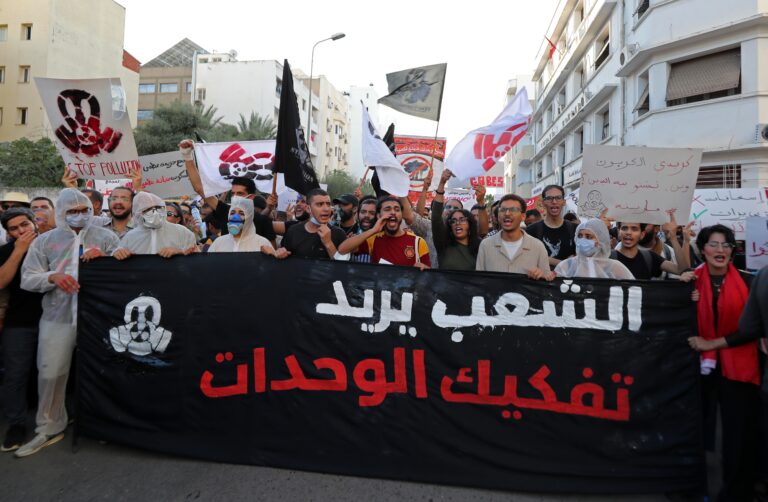
This paper analyzes the interaction between three key parties through a deductive approach (general to specific). There is the monarchy whose influence oscillates between symbolic and actual presence, which determines the country’s major orientations; and there are the government and parliament, which make decisions through policies in line with development demands. We also find stakeholders demanding the right to spatial justice. They act as pressure groups exposing policy limitations and perhaps challenge the dominant official discourse in order to influence official actors’ behavior, directing them towards their demands and forcing them, in many cases, to adopt particular decisions. This can be seen in the case of the Al-Hoceima movement in northern Morocco,2The term “Rif” does not refer to the distinction between rural and urban areas, but rather to a Moroccan region stretching across the Rif mountain range in northern Morocco, which includes Moroccan cities that share a common cultural character, such as Al-Hoceima, Nador, Tetouan, and others. where spatial justice became a declared social demand after the region witnessed, in late October 2016, a popular uprising following the killing of fishmonger Mouhcine Fikri.
Endnotes
| ↑1 | Spatial justice, as it is called in Morocco, references space. In other countries the term could be “geographical justice” in reference to place. |
|---|---|
| ↑2 | The term “Rif” does not refer to the distinction between rural and urban areas, but rather to a Moroccan region stretching across the Rif mountain range in northern Morocco, which includes Moroccan cities that share a common cultural character, such as Al-Hoceima, Nador, Tetouan, and others. |