





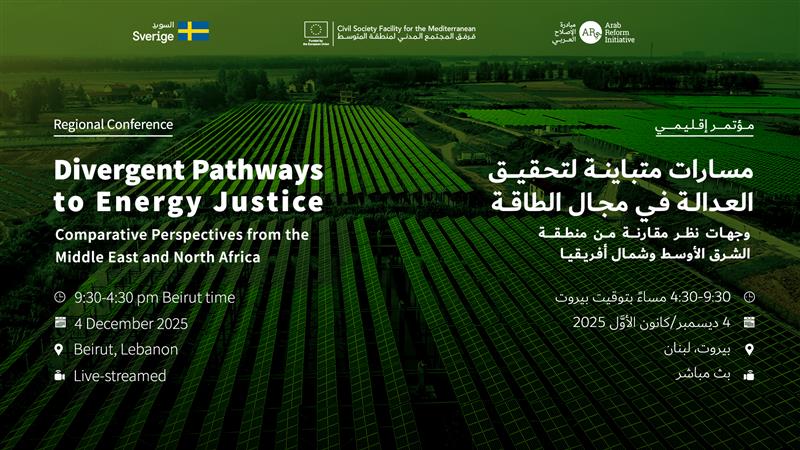
You can register to attend by following this link. You will receive a Zoom confirmation email should your registration be successful. Alternatively, you can watch the event live here on our Facebook page.
To attend in-person please use this link. To Download the agenda from here.
This conference will take place in the Gefinor Rotana Hotel – Beirut
The MENA region stands at a crossroads where environmental, social, economic and political challenges converge. Climate change, conflict, and structural economic dependence on hydrocarbons and food imports intensify vulnerabilities across societies. Against this backdrop, the Arab Reform Initiative (ARI), in partnership with regional actors and partner institutions is convening a conference dedicated to advancing a Just Energy Transition (JET). Recognizing the existing fragmentation in energy pathways in the region between countries emerging from conflict and leading energy exporters, the conference seeks to explore what spaces exist for new forms of regional solidarity and collaboration. This convening is part of ARI’s broader effort to build knowledge, strengthen civil society participation, and open dialogue amongst civil society actors, researchers and practitioners, on how to make energy transitions more inclusive, equitable, and resilient. The event will bring together researchers, civil society actors, policymakers, and international partners from across the region, creating a vibrant space for debate, knowledge exchange, and collective strategizing.
Scope and participation
The conference will explore what a just energy transition means in contexts of conflict, rentier economies, and different governance structures of energy sectors in the region.
The event will focus on the evolving dynamics of energy transitions across these contexts, highlighting how national experiences intersect with broader regional trends. Structured around comparative panels and expert discussions, the conference will examine the diverse political, economic, and institutional conditions shaping transition pathways – from conflict-affected environments in the Levant and Yemen, to hydrocarbon-dependent economies in North Africa, alongside the Gulf’s expanding role in regional energy investments and major efforts at economic diversification.
Participation will bring together researchers, civil society organizations, practitioners, and regional experts. Their contributions will help unpack the governance challenges, equity concerns, and interdependence dynamics that shape energy access, infrastructure resilience, and the capacity of states and societies to advance fairer transition models. Through dialogue between experts and grassroots actors, the conference aims to identify practical avenues for regional collaboration and collective action grounded in justice, inclusion, and context-sensitive policymaking.
Agenda
9:00- 9:30: Registration
9:30-9:45: Opening Remarks
9:45- 11:15: Panel 1: Regional Perspectives on a Just Energy Transition in Conflict Settings-Experiences from Lebanon, Palestine, Syria and Yemen
This panel covers the Levantine countries and Yemen – all facing the consequences of conflict – and in the case of Palestine of occupation.
Speakers:
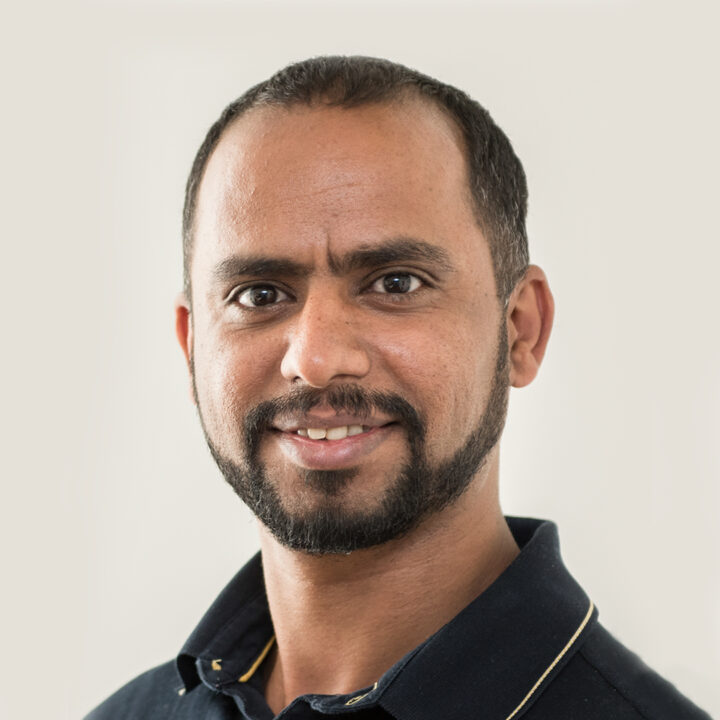
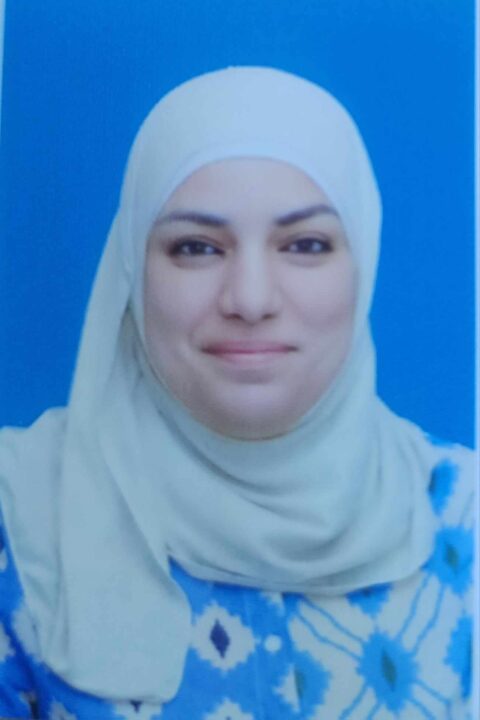
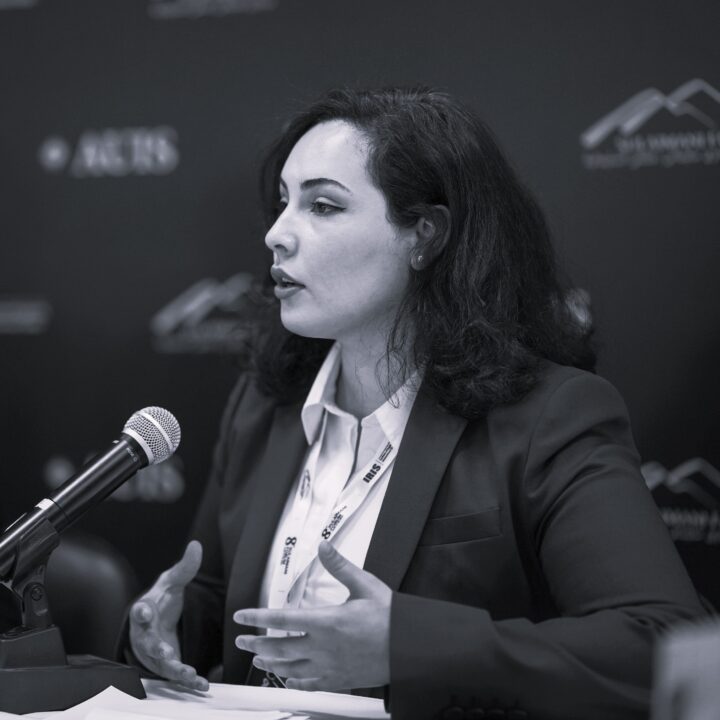
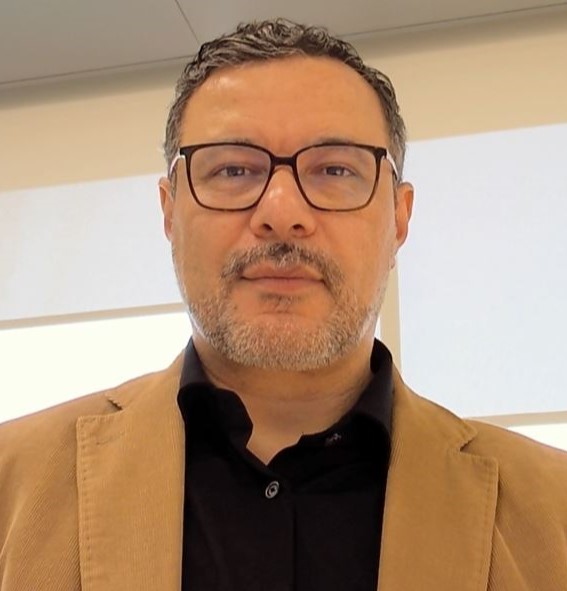
- Musaed Aklan, Senior Researcher, Sana’a Center for Strategic Studies
- Iyas Shahin, Founder & CEO, IWlab
- Abeer Butmeh, Coordinator, Palestinian Environmental NGOs Network
- Yasmina El Amine, PhD candidate (UCL) and a research consultant, Arab Reform Initiative
Moderator: Dana Abi Ghanem, Deputy Director for EPP, Arab Reform Initiative
The session will explore how fragile states and occupied countries approach the shift to greener energy solutions while responding to urgent recovery needs and humanitarian emergencies.
What Energy Justice Means in These Contexts
The meaning of “energy justice” in such contexts is broad and depends on the realities of each country. In Palestine, it is grounded in the struggle for sovereignty and decolonization, where energy access is fundamentally shaped by occupation and external control. In Syria, energy justice is tied to restoring affordable energy access for communities and individuals to allow them to resume their lives and the need for both humanitarian and financial recovery after years of war. Lebanon’s context highlights the importance of equity and transparency in a system long characterized by elite-driven dysfunction and chronic mismanagement. In Yemen, justice is understood through the lens of reconstruction amid extreme fragility, where the collapse of infrastructure makes even basic energy access a challenge.
Together, these cases illustrate a fragmented regional energy landscape and demonstrate that “just transition” cannot follow a single pathway. Instead, it emerges as a spectrum of struggles shaped by conflict, occupation, authoritarian governance, economic crises, and institutional precarity. A comparative perspective underscores that justice in energy transitions must be firmly context-specific, while also emphasizing cross-cutting principles such as sovereignty, effective humanitarian interventions, good governance, equity, and the protection of key rights to allow for meaningful participation and oversight by civil society – particularly for marginalized communities.
The discussion will also reflect on how conflict reshapes governance of energy systems, who controls resources and who is excluded, how fragile states secure basic energy needs, and how sovereignty constraints – such as blockades or occupation-affect access. It will explore how to balance urgent short-term needs with long-term planning, and whether shared lessons or avenues for collaboration can emerge across these contexts.
11:15-11:30: Coffee Break
11:30- 13:00: Panel 2: Regional Perspectives on a Just Energy Transition in Oil-Producing Countries – Experiences from Algeria, Iraq, and the GCC
This panel examines Algeria and Iraq – two of the region’s most hydrocarbon-dependent countries – alongside perspectives from the GCC, where oil-producing states are pursuing varying pathways of diversification and decarbonization.
Speakers:
- Adam Mokrani, Attorney at Law and research consultant, Arab Reform Initiative
- Radhouan Ben-Hamadou, Director, Research and Policy Development, Earthna
- Shayan Kamil, Research Fellow, Institute of Regional and International Studies (IRIS) at the American University of Iraq, Sulaimani
- Dhabia Al-Mohannadi, Associate Professor at the College of Science and Engineering, Hamad Bin Khalifa University
Moderator: Mac Skelton, Executive Director, Institute of Regional and International Studies (IRIS) at the American University of Iraq, Sulaimani
This session will explore how Algeria, Iraq, and Gulf states are redefining their energy futures while navigating the pressures of decarbonization, shifting global markets, and internal socio-economic demands. It will examine the political economy of hydrocarbons and how national debates shape transition priorities.
Any discussion on energy transition in these countries must consider deeply entrenched rentier structures, heavy dependence on oil and gas revenues, and complex governance systems.
Both Algeria and Iraq face structural barriers that shape their transition trajectories: centralized institutions, uneven territorial development, subsidy systems, regulatory weaknesses, youth-dominated populations, and strong social pressures linked to unemployment and inequalities.
In parallel, GCC producers such as Qatar and Bahrain are pursuing diversification strategies driven by shifting global markets and the evolving role of national energy companies. These Gulf trajectories provide a contrasting reference point for understanding what forms of justice and reform might be possible – or constrained – elsewhere in the region.
What Energy Justice Means in These Contexts
The agenda for “energy justice” varies significantly across Algeria, Iraq, and the Gulf.
In Iraq, justice is tied to harm reduction, accountability, and community protection in a sector marked by extreme gas flaring, weak regulatory institutions, and severe environmental and health impacts. In Algeria, justice revolves around intergenerational equity, territorial inclusion, and demands for decentralization within a highly centralized political economy.
In GCC states, justice emerges in debates on welfare redistribution, the role of state-owned companies, and the management of revenues during diversification. These differences illustrate how each context defines fairness, responsibility, and long-term sustainability according to its own political and socio-economic realities.
The energy transition across these countries reveals a fragmented regional landscape. Iraq begins from a context of entrenched rentierism, environmental degradation, and weakened institutions, requiring immediate measures to reduce harm. Algeria faces long-term structural challenges such as regressive subsidies, governance centralization, and uneven development, making equity and long-term restructuring central to its transition narrative.
GCC states, by contrast, are repositioning themselves through ambitious diversification strategies, transforming national oil companies, and mobilizing large-scale investments in low-carbon technologies. These experiences highlight that a “just transition” is not a unified framework, but a spectrum of pathways shaped by political economy, institutional capacity, and socio-economic pressures.
A comparative perspective underscores that justice must be context-specific while also grounded in broader principles: economic diversification, good governance, equity, intergenerational fairness, environmental responsibility, and meaningful participation of communities and civil society.
The discussion will further examine how governance structures and rentier systems shape transition priorities; what reforms are needed for state-owned enterprises such as Sonatrach, Sonelgaz, and Iraq’s national oil companies to become drivers rather than barriers to transition; the extent to which GCC trajectories offer transferable lessons for Algeria and Iraq; and how civil society, youth, and communities can meaningfully influence policymaking in highly centralized and resource-dependent contexts.
13:00 – 14:30: Lunch
14:30 – 16:00: Panel 3: Regional Interdependence and Cooperation for a Just Energy Transition in MENA
This panel examines how regional interdependence – through energy trade, investments, infrastructure, and political economy – shapes energy transitions across MENA. It brings together experts and civil society organizations to explore how cooperation between the Gulf, North Africa, and the Levant can advance justice-focused energy pathways, especially in conflict-affected or structurally fragile contexts such as Syria and Lebanon.
Speakers:
- Amel Boubakeur, Non-resident Senior Fellow, Arab Reform Initiative, Lecturer, American University of Paris
- Alaa Shehabi, Associate Professor for Teaching in Middle East Politics, University College London Department of European and International Social and Political Studies
- Basima Abdulrahman, Founder & CEO, KESK
- Yasser Helal, Editor in Chief, Taqamena.com
Moderator: Diana El Kaissi, Energy Governance Specialist
Every country in the MENA region is working – in different ways and at different speeds – to define its energy transition. Yet these transitions are not isolated: energy systems, markets, and political decisions spill across borders. MENA energy landscapes are linked by pipelines, trade routes, electricity grids, investment flows, and geopolitical alignments.
This session explores how the Gulf’s growing role in regional energy financing, infrastructure development, and low-carbon investment intersects with the needs of countries like Algeria, Iraq, Lebanon, and Syria, where justice concerns are shaped by conflict, economic crisis, governance deficits, and vulnerabilities in energy access.
The panel will investigate how cooperation can enhance sovereignty, resilience, and equity – or, if poorly designed, deepen dependency.
For the Levant, energy access is directly tied to regional dynamics: Lebanon depends on external fuel sources and fragmented supply routes. Syria’s energy sector is shaped by war, sanctions, and competing political influences. Meanwhile, cross-border gas and electricity deals face political constraints and humanitarian considerations.
North Africa, meanwhile, negotiates its own interdependence: exporting gas to Europe, exploring hydrogen corridors, and managing internal inequalities shaped by centralization and the regional political economy of energy.
Understanding these linkages is essential for designing cooperation that aligns with justice rather than geopolitical expediency.
What Justice Means in a Regional Transition
Justice in a cross-regional context focuses on addressing unequal access to capital, technology, and political influence.
For countries like Lebanon and Syria, justice requires energy security, ensuring access to energy at affordable rates for the most vulnerable, and protection of sovereignty in a context where infrastructure is fragile and governance is contested.
For North African countries, justice centers on equitable territorial development, fair pricing, transparency in trade agreements, and ensuring that export-oriented projects do not reproduce extractive relationships.
For GCC countries in this context, energy justice involves transparent and accountable investment pathways that support sustainability and access goals for the region, not only domestic diversification.
A just regional transition must also address the risk that Gulf investments may prioritize geopolitical influence or profitability over community needs, accountability, or long-term resilience.
These forms of engagement raise critical questions about the capacity of Gulf investments to support energy access, reconstruction, and equitable recovery in fragile contexts; the conditions required to avoid reinforcing existing dependencies or power asymmetries; and the principles of transparency, participation, and community inclusion needed to guide regional cooperation and long-term sustainability.
The discussion will also explore how the Gulf can support countries like Syria, Lebanon, and others in strengthening their energy transitions; the regional investment landscape already in place; the financial mechanisms that could enable cross-border cooperation; how regional energy solidarity can be institutionalized through grids, gas trade, or renewable corridors; and how CSOs and non-state actors can gain meaningful influence in regional energy governance traditionally dominated by states and national oil companies.