




War magnifies existing inequalities, leaving populations already exposed to myriad forms of injustice even more vulnerable to its devastating impact. The quest for justice has taken many forms, such as social justice, environmental justice, and distributive justice. Yet, one aspect of this often-overlooked pursuit is spatial justice, which seeks to limit inequalities that emerge from spatial (re)organization. This article explores the spatial dimension of justice and its implications during war and post-war periods in the MENA region. At its essence, it to answer a central question: How does enduring 13 months of war exacerbate the realities of spatial injustice for populations already burdened by systemic inequities, and what does this mean for their prospects of recovery and reconstruction? To explore this, we interviewed a researcher (J.S.)1The interviewee asked to remain anonymous and will be referred to hereafter as J.S. at Public Works Studio, a Lebanese association dedicated to multidisciplinary research and design that “engages critically and creatively” with several “urban and public issues” across the country.2Public Works Studio, “About Us”, https://publicworksstudio.com/en/about-us/ This article will unpack the concept of spatial justice, with insights from the Public Works researcher, placing it vis-à-vis war-induced destruction and post-war reconstruction.
Spatial justice is a concept that deals with “the fair and equitable distribution in space of socially valued resources and the opportunities to use them.”3Edward W. Soja, “The City and Spatial Justice” [La Ville et la Justice Spatiale], Sophie Didier and Frédéric Dufaux (trans.), Justice Spatiale-Spatial Justice, no. 1, (2009), https://www.jssj.org/article/la-ville-et-la-justice-spatiale/ Developed over decades, various scholars, such as David Harvey, David Smith, and Iris Marion Young,4Stephen Przybylinski, “Spatial Justice”, In Theorising Justice: A Primer for Social Scientists, Johanna Ohlsson and Stephen Przybylinski eds., Bristol University Press, 2023, pp. 191–204, https://doi.org/10.51952/9781529232233.ch012 [Przybylinski, “Spatial Justice”] introduced different approaches to discussions on spatiality of justice. The concept of spatial justice did not accumulate until the early 2000s.5Przybylinski, “Spatial Justice”. And even though South African geographer Gordon Pirie coined the term in the 1980s, it did not gain traction till much later when geographer Edward Soja re-conceptualized the notion of space on which scholar Mustafa Dikeç built his notion of justice.6Przybylinski, “Spatial Justice”. Thus, the term – and the principles that took decades to develop – not only refers to city planning, but in an era of globalized urbanization, it has come to encompass all inhabitable geographies, offering a critical lens to assess the living standards produced by the process of urbanization. Spatial justice is then “a demand for greater control over how the spaces in which we live are socially produced wherever we may be located.”7Edward W. Soja, Seeking Spatial Justice, University of Minnesota Press, 2010, p. 7. In other words, spatial injustice means the disparity in the quality of living in different spaces. To give an example, think of Independence Street in Bourj Hammoud, more colloquially known as “Achrafieh Bridge”.
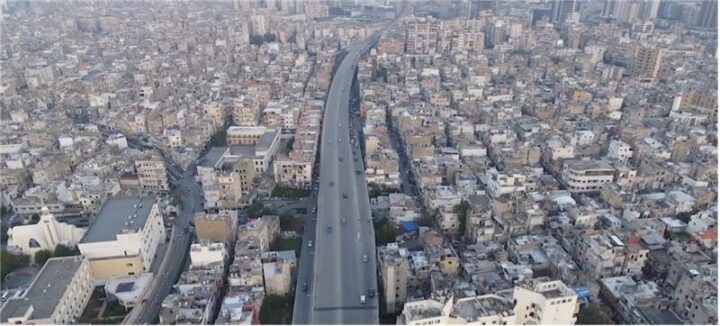
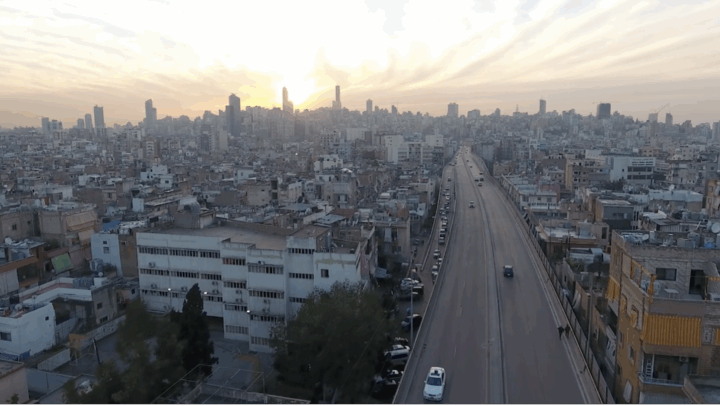
The bridge, pictured above, cuts through an entire neighborhood in Bourj Hammoud, connecting the Beirut neighborhoods of Dekwaneh, Bourj Hammoud, and Achrafieh. It runs between buildings of four stories or higher. This layout burdens the population with noise and air pollution, among other things, degrading their quality of life. As the Public Works researcher explains, spatial justice seeks to “ensure that all individuals, regardless of their socioeconomic status, ethnicity, or background, have equal access to essential resources like housing, transportation, healthcare, green spaces, and public facilities.” This concept, of course, can be applied at different levels – within neighborhoods, municipalities, state(s), and internationally.
Since 8 October 2023, Public Works Studio has built an online map that aims to “track and document [the Israeli] attacks to understand their cumulative impact on our built and natural environment, and on our lives as residents.”8Rayan Alaeddine and Asmaa Ghrawi, “Map of Israeli Attacks on Lebanon 2023”, Public Works Studio, July 2024, https://publicworksstudio.com/en/map-of-israeli-attacks-on-lebanon-2023/ [Aleddine and Ghrawi, “Map of Israeli Attacks on Lebanon 2023”] Through daily monitoring of news (via social media, televised news, or others), the studio collects and verifies the data before updating the map. According to Public Works’ documentation, Israel bombed 429 villages across Lebanon from 8 October 2023 till 31 October 2024. These attacks killed 4,047 and injured 16,638, according to the Lebanese Ministry of Health,9National News Agency (NNA), “4,047 Martyrs and 16,638 Wounded, the Total Updated Toll of the Israeli Aggression”, Ministry of Public Health, Republic of Lebanon, 4 December 2024, https://tinyurl.com/mnm88tcw [NNA, “4,047 Martyrs and 16,638 Wounded”] and caused the displacement of about 1.2 million people, as per Lebanese Government estimates.10United Nations High Commissioner for Refugees, “UNHCR: Lebanon Crisis Deepens as Israeli Airstrikes Intensify”, 15 October 2024, https://tinyurl.com/2ecv56yy Discussing spatial (in)justice in times of war in Lebanon evokes many terms, such as ecocide and urbicide, which were repeatedly used to describe Israeli attacks. Therefore, to unpack the reality of spatial (in)justice it is essential to first address these terms.
Ecocide Construction and Legal Implications
Stop Ecocide International convened an independent panel of expert lawyers to define ecocide as the “unlawful or wanton acts committed with knowledge that there is a substantial likelihood of severe and either widespread or long-term damage to the environment being caused by those acts.”11Stop Ecocide International, “Historic Moment as Independent Expert Panel Launches Definition of Ecocide”, June 2021, https://www.stopecocide.earth/legal-definition It should be noted, however, that ecocide is not explicitly and independently classified as a war crime under international law12Existing international legal frameworks prohibit severe environmental destruction during armed conflict. Article 8(2)(b)(iv) of the Rome Statue considers it a war crime to intentionally cause widespread, long-term, and severe damage to the natural environment if it is disproportionate and not justified by military necessity..See International Criminal Court (ICC), Rome Statue of the International Criminal Court, ICC 2021, https://www.icc-cpi.int/sites/default/files/2024-05/Rome-Statute-eng.pdf – not yet at least. A proposal to amend the Rome Statute of the International Criminal Court to add ecocide was introduced on 9 September 2024.13Stop Ecocide International, “Mass destruction of nature reaches International Criminal Court (ICC) as Pacific Island States Propose Recognition of ‘Ecocide’ as International Crime”, 9 September 2024, https://tinyurl.com/2s49btts However, even if the amendment passes, individual states need to adopt laws that recognize ecocide as a punishable crime. With Lebanon and Israel being non-ratifying states of the Rome Statute,14International Criminal Court, “The States Parties to the Rome Statute”, https://asp.icc-cpi.int/states-parties the amendment is non-binding, unless they independently legislate ecocide as a crime. Even so, Public Works is working to encourage the correct use of terms like ecocide and have used it to describe Israeli attacks on Lebanese-border towns and forests.15Aleddine and Ghrawi, “Map of Israeli Attacks on Lebanon 2023”.
These strikes ranged from targeting civilian places and heritage sites to forests and agricultural lands. Since 8 October 2023, according to Public Works, during the first few months of war, Lebanese southern forests had been a direct target of Israeli aggression. This environmental attack resulted in “the burning of over 2,000 hectares of land, more than 1,200 of which were forests”, according to the National Council for Scientific Research.16National Center for Natural Hazards and Early Warning (NCNE), Report on Israeli Offensive against Lebanon 2023-2024, National Council for Scientific Research (CNRS-L), December 2024, https://www.cnrs.edu.lb/english/publication/cnrsbooks/war-report-2023-2024 “The attacks destroyed thousands of olive trees, hundreds of green houses and water irrigation infrastructure”, according to the researcher at Public Works. J.S. further points out that Israeli forces deliberately targeted forests and agricultural lands using white phosphorous. strategically taking advantage of South Lebanon’s hard-to-access rocky landscape and burnt lands to extinguish fires on time. They also “targeted firefighters attempting to put out the flames”, which further delayed responses to the fires. According to the Public Works monitoring, white phosphorous was used heavily on forests, farmlands, and villages bordering Israel, significantly impacting farmers and residents on agricultural fields, “either by destroying the crops and polluting the soil or by preventing farmers from accessing their land and crops”, elaborates J.S. The long-term damage of white phosphorous is caused by the release of phosphoric acid, which infiltrates the soil and ground water, or disperses into the air. This remains in the soil for many years, consequently contaminating crops and reducing the soil’s fertility, rendering it “unsuitable for future crop cultivation” and elevates the risk of soil erosion, according to the interviewee. The long-term residue of this component affects local ecological cycles, meaning crops and water sources can become contaminated for a long period of time, impacting “animals and humans dependant on them.” The researcher adds, between 8 October 2023 and 31 October 2024, Israel used “[white phosphorous] bombs 316 times in Lebanon, .” This is a case of ecocide, as Israel is deliberately disturbing “the balance of nature and eliminating local environmental, cultural, and agricultural means of livelihood”, said J.S.
Linking Ecocide to the Spatial (In)Justice Context
The Public Works researcher explains that understanding spatial (in)justice in the context of war involves observing the detonated towns on the border of southern Lebanon. J.S. states: “mapping the detonated towns and seeing them in relation to the border, the border itself is one demarcation line of social injustice, and how the aim of detonating border towns is to create a spatial zone where life itself is killed.” J.S. goes on to highlight the spatial objective of phosphorous attacks is to annihilate natural life in these affected areas. Ecocide, in this case, is thus a catalyzer for exacerbating spatial injustice. The interviewee exposes multiple alarming observations:
First, the border itself marks the starting line for enacted violence. The act of environmental assault does not only concern physical destruction, it is an effort to reshape the geographical space itself. By making these arable lands uninhabitable and unsuitable for cultivation, war creates zones of exclusion and death. This violates the principles of spatial justice, which advocate for spaces to be safe, livable, and conducive to human and ecological well-being.17Roberto Rocco, Juliana E. Gonçalves and Hugo Lopez (eds.), The Spatial Justice Handbook. TU Delft Open Publishing, https://doi.org/10.5281/zenodo.12598019 Second, as these green spaces have become deliberate targets, human and non-human communities within this area are exposed to myriad levels of vulnerability and left with an ultimatum: leave or risk dying. As Israeli attacks have not spared hospitals, civil defense facilities, and medics in the South,18NNA, “4,047 Martyrs and 16,638 Wounded”; Hanna Duggal and Marium Ali, “Mapping Israeli Attacks on Lebanon’s Healthcare System”, Al Jazeera, 17 November 2024, https://tinyurl.com/mrxhmr5s a population that decides to stay are left with poor resources to cater to their medical or daily needs. This, coupled with the long-term effects of white phosphorous bombs that render landscapes hazardous and infertile, destroys any prospects for sustainable livelihoods and ecological recovery.19Antoine Kallab and Leila Rossa Mouawad, “Addressing the Socio-Environmental Impact of White Phosphorous Ammunition in South Lebanon: Analysis and Risk Mitigation Strategies”, American University of Beirut Nature Conservation Center, November 2023, https://www.aub.edu.lb/natureconservation/Documents/Brief%20WP%20English.pdf And third, as well as physical and ecological damage, the deliberate targeting of these spaces represents symbolic annihilation, erasing histories and identities tied to the land.
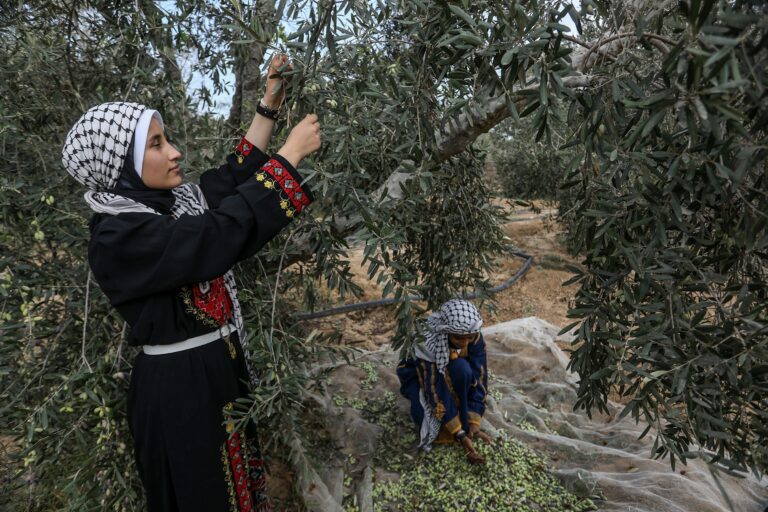
The targeting of agricultural land isolates the population that tended to the land’s needs, rendering their cultural practices obsolete. In turn, it serves their connection to their land. As the interviewee explains, ecocide “is the extensive and deliberate destruction of the environment… resulting in cultural genocide by erasing traditional ways.” Destroying the ecological balance of a geographical space disrupts the inevitable routines for maintaining this balance. Additionally, these routines – like the olive-picking season – create a certain human activity that evolves into cultural practices. Thus, ecocide does more than destroy ecosystems, it erodes the social and cultural fabric. This compounding effect deepens spatial injustice, and denies people the right to exist and thrive in their own environments.
The Concept of Urbicide: From Global to National Definitions and Usage
In February 2024, the number of white phosphorus attacks on the South “decreased as the pace of bombing civilian neighborhoods and homes increased.” These bombings, according to J.S., constitute a case for urbicide, a term that translates to “city-killing”.20Charlie Lawrence Jones, “Urbicide: The Killing of a City is an Attack on the Human Condition”, City Monitor, 23 January 2018, https://www.citymonitor.ai/analysis/urbicide-killing-city-attack-human-condition-3617/?cf-view It refers to the violence against “the built environment”,21Martin Coward, Urbicide: The Politics of Urban Destruction, Routledge, 2009, p. 35. [Coward, Urbicide] or as the interviewee explained: “the premediated, ordered, and explicit destruction of urban areas through widespread deliberate violence.” An example of such acts is the complete destruction of towns, such as Kfarkila and Yarin, where buildings and neighborhoods have been levelled, resulting in the “disruption of social and cultural networks, the displacement of populations, and the erasure of collective memory.” Urbicide thus occurs when attacks or aggression deliberately destroy essential infrastructure that makes up the very social and cultural fabric of a city’s urban life, impacting its human capital. The interviewee adds that since 23 September 2024 –the day marked an escalation in hostilities – southern suburbs of Beirut were bombed relentlessly. This can be considered a deliberate act of urbicide. The attacks show a “calculated strategy to eradicate civilian spaces, and to further install terror amongst the population”, exposing an intentional “assault on the very fabric of community life, as primary residential or mixed-use buildings were targeted.”
Technically, urbicide is the act of destroying cities, however its ripple effect goes beyond the sheer physical state of destruction. The researcher explains: “by turning homes and businesses and public services into ruble, the attacks are severing the connections between people and their neighborhoods, dismantling the social bonds that define the community.” Therefore, the damage to the targeted areas goes beyond the physical realm that reaches “profound social disintegration”, as people not only flee “in a heightened state of stress” but they are also “witnessing the erasure of their culture and physical [and symbolic] ties to their land.”
The question then becomes: what connects urbicide to spatial justice?
Exploring Urbicide’s Ramifications: Displacement
During the war, intense shelling forced people to flee in search of safety. However, the absence and delay of a governmental emergency plan left them to their woes. Unregulated, rental fees gave landlords the power to capitalize on people’s dire need for housing, driving up costs and creating unequal access to housing for displaced individuals. Many took shelter in schools and official institutions in different areas – such as Zahle, Bekaa, Tyre, Baalbak-Hermel, Beirut and its surrounding areas, and Tripoli – after Interior and Municipalities Minister Bassam Mawlawi instructed regional governors to cooperate in assisting displaced civilians.22L’Orient Today, “Interior Minister Orders Opening of Schools as Shelters for Displaced from Southern Lebanon”, 23 September 2024, https://tinyurl.com/3x95h284 According to a report by the International Organization for Migration (IOM), Beirut became the primary destination for displaced individuals, with 16% of Internally Displaced Persons (IDPs) seeking refuge in the city. 23Displacement Tracking Matrix, “Lebanon: Middle East and North Africa”, International Orgnization for Migration, https://dtm.iom.int/lebanon They resorted to living in collective family- or friends-hosted shelters, renting housing units, squatting in empty buildings, or sleeping in their cars. To put it in perspective, on 21 November 2024, IOM reported that Beirut district hosted 138,211 IDPs spread across 12 cadasters, while the Chouf district accommodated 155,942 IDPs distributed across 84 cadasters.24Displacement Tracking Matrix, Mobility Snapshot – Round 64, International Orgnization for Migration, 21 November 2024, https://dtm.iom.int/reports/mobility-snapshot-round-64-21-11-2024
This unbalanced distribution among governorates means overpopulated areas faced deteriorating living standards, marked by limited access to resources or services, and increased noise and air pollution due to a high concentration of cars. Such living conditions perpetuate cycles of hardship, creating tension among the displaced and hosting communities, and making it difficult for all concerned to attain stability, safety, security, and well-being.
As Coward (2009) states: “Political violence is the deployment of violence to influence the nature of being-with-others in a specific instance. The destruction of buildings thus comprises a fundamentally political form of violence.”25Coward, Urbicide, p. 14. This statement highlights that urbicide represents more than the mere physical destruction of buildings, its spillover-effect hinders the cohesion of communities. Through displacement, it leads to scattering populations as they seek shelter, undermining the very fabric of communal togetherness. Within this framework of political, physical, and environmental violence, spatial injustice is thus heightened. The by-product and catalyzer of such a chain is the disruption of the social fabric, the presence of which can become a lifeline in times of crisis.
Spatial Justice in a Post-War Context
In brief, disrupting the social fabric is a common by-product of ecocide and urbicide. As the ceasefire deal has come into effect on 27 November 2024 – regardless of its legitimacy and adherence – the pressing question becomes, in this context, how to restore the fabric lost while ensuring a sustainable living standard for all? The short answer revolves around spatial justice.
As J.S. points out, the reconstruction and rehabilitation phase “will come with a significant material, ecological, and financial cost.” This phase relies heavily on the use of cement to rebuild what has been destroyed. In Lebanon, according to a law passed in 1993, the import of cement is prohibited.26Land Policy Observatory, “Land Policies in Lebanon: Timeline”, Public Works Studio, https://publicworksstudio.com/en/observatory/land-policies/ This makes the environment a primary source to rebuild towns affected by Israeli shelling, which raises concerns about sustainability and long-term ecological and health damage, as “cement factories pollute the soil, river, and air, impacting both human and non-human communities.” The interviewee continues: “Lebanese cement companies extract a minimum of three million cubic meters of gravel and sand annually, which means they convert 50 hectares of lands and mountains into quarries every year. Nationally, over 15 million square meters of land have been quarried since 2022. Roughly 75% of the Beirut area… these numbers will likely increase during reconstruction, intensifying natural environmental destruction.” Spaces bearing the burden of this extractive, mostly unregulated industry, will also face severe environmental degradation, depleting living and health standards for the inhabitants.
The uneven burden of environmental damage that this unregulated practice imposes exposes inhabitants to heightened health risks, water contamination, and soil degradation; further compromising quality of life and the ability to sustain livelihoods. Centering spatial justice in this framework invites environmental prioritization, which subsequently ensures the well-being of human and non-human residents.
The interviewee further adds that ensuring spatial justice entails different steps:
- prioritizing the restoration of the social and economic life, alongside the physical reconstruction;
- enabling residents to return with dignity and without delay;
- applying standards of inclusion… to ensure accessibility for all groups; and
- ensuring sustainable housing for all groups through various access pathways and providing fair and affordable rent in rehabilitated areas.
This means eliminating obstacles that might hinder mending the torn social fabric. If these steps were taken into consideration during the reconstruction phase, the displaced population would return to their hometowns and resume their long-bound daily practices together as a community.
Conclusion
Israeli hostilities left Lebanese towns, forests, and agricultural lands uninhabitable. Navigating spatial justice in such a context brought up themes of ecocide and urbicide, which exposed the extent of the damage, that went beyond physical destruction to hinder the social fabric of Lebanese societies. Additionally, when envisioning the post-war period, spatial justice dusted off existing injustices that needed addressing. The concept of spatial justice thus served both as a magnifying lens to critically analyse war’s ramifications and as a tool with which rehabilitation plans must be shaped. Spatial justice, in other words, is a framework within which one critically looks at the “spatiality of injustice”27Przybylinski, “Spatial Justice”. and the “injustice of spatiality”,28Przybylinski, “Spatial Justice”. guaranteeing safe, secure, and sustainable livelihoods for human and non-human communities. As J.S. rightly asserts: “It’s crucial to recognize that spatial justice… involves challenging underlying power and spatial practices that create social and economic inequalities.”
Endnotes
| ↑1 | The interviewee asked to remain anonymous and will be referred to hereafter as J.S. |
|---|---|
| ↑2 | Public Works Studio, “About Us”, https://publicworksstudio.com/en/about-us/ |
| ↑3 | Edward W. Soja, “The City and Spatial Justice” [La Ville et la Justice Spatiale], Sophie Didier and Frédéric Dufaux (trans.), Justice Spatiale-Spatial Justice, no. 1, (2009), https://www.jssj.org/article/la-ville-et-la-justice-spatiale/ |
| ↑4 | Stephen Przybylinski, “Spatial Justice”, In Theorising Justice: A Primer for Social Scientists, Johanna Ohlsson and Stephen Przybylinski eds., Bristol University Press, 2023, pp. 191–204, https://doi.org/10.51952/9781529232233.ch012 [Przybylinski, “Spatial Justice”] |
| ↑5 | Przybylinski, “Spatial Justice”. |
| ↑6 | Przybylinski, “Spatial Justice”. |
| ↑7 | Edward W. Soja, Seeking Spatial Justice, University of Minnesota Press, 2010, p. 7. |
| ↑8 | Rayan Alaeddine and Asmaa Ghrawi, “Map of Israeli Attacks on Lebanon 2023”, Public Works Studio, July 2024, https://publicworksstudio.com/en/map-of-israeli-attacks-on-lebanon-2023/ [Aleddine and Ghrawi, “Map of Israeli Attacks on Lebanon 2023”] |
| ↑9 | National News Agency (NNA), “4,047 Martyrs and 16,638 Wounded, the Total Updated Toll of the Israeli Aggression”, Ministry of Public Health, Republic of Lebanon, 4 December 2024, https://tinyurl.com/mnm88tcw [NNA, “4,047 Martyrs and 16,638 Wounded”] |
| ↑10 | United Nations High Commissioner for Refugees, “UNHCR: Lebanon Crisis Deepens as Israeli Airstrikes Intensify”, 15 October 2024, https://tinyurl.com/2ecv56yy |
| ↑11 | Stop Ecocide International, “Historic Moment as Independent Expert Panel Launches Definition of Ecocide”, June 2021, https://www.stopecocide.earth/legal-definition |
| ↑12 | Existing international legal frameworks prohibit severe environmental destruction during armed conflict. Article 8(2)(b)(iv) of the Rome Statue considers it a war crime to intentionally cause widespread, long-term, and severe damage to the natural environment if it is disproportionate and not justified by military necessity..See International Criminal Court (ICC), Rome Statue of the International Criminal Court, ICC 2021, https://www.icc-cpi.int/sites/default/files/2024-05/Rome-Statute-eng.pdf |
| ↑13 | Stop Ecocide International, “Mass destruction of nature reaches International Criminal Court (ICC) as Pacific Island States Propose Recognition of ‘Ecocide’ as International Crime”, 9 September 2024, https://tinyurl.com/2s49btts |
| ↑14 | International Criminal Court, “The States Parties to the Rome Statute”, https://asp.icc-cpi.int/states-parties |
| ↑15 | Aleddine and Ghrawi, “Map of Israeli Attacks on Lebanon 2023”. |
| ↑16 | National Center for Natural Hazards and Early Warning (NCNE), Report on Israeli Offensive against Lebanon 2023-2024, National Council for Scientific Research (CNRS-L), December 2024, https://www.cnrs.edu.lb/english/publication/cnrsbooks/war-report-2023-2024 |
| ↑17 | Roberto Rocco, Juliana E. Gonçalves and Hugo Lopez (eds.), The Spatial Justice Handbook. TU Delft Open Publishing, https://doi.org/10.5281/zenodo.12598019 |
| ↑18 | NNA, “4,047 Martyrs and 16,638 Wounded”; Hanna Duggal and Marium Ali, “Mapping Israeli Attacks on Lebanon’s Healthcare System”, Al Jazeera, 17 November 2024, https://tinyurl.com/mrxhmr5s |
| ↑19 | Antoine Kallab and Leila Rossa Mouawad, “Addressing the Socio-Environmental Impact of White Phosphorous Ammunition in South Lebanon: Analysis and Risk Mitigation Strategies”, American University of Beirut Nature Conservation Center, November 2023, https://www.aub.edu.lb/natureconservation/Documents/Brief%20WP%20English.pdf |
| ↑20 | Charlie Lawrence Jones, “Urbicide: The Killing of a City is an Attack on the Human Condition”, City Monitor, 23 January 2018, https://www.citymonitor.ai/analysis/urbicide-killing-city-attack-human-condition-3617/?cf-view |
| ↑21 | Martin Coward, Urbicide: The Politics of Urban Destruction, Routledge, 2009, p. 35. [Coward, Urbicide] |
| ↑22 | L’Orient Today, “Interior Minister Orders Opening of Schools as Shelters for Displaced from Southern Lebanon”, 23 September 2024, https://tinyurl.com/3x95h284 |
| ↑23 | Displacement Tracking Matrix, “Lebanon: Middle East and North Africa”, International Orgnization for Migration, https://dtm.iom.int/lebanon |
| ↑24 | Displacement Tracking Matrix, Mobility Snapshot – Round 64, International Orgnization for Migration, 21 November 2024, https://dtm.iom.int/reports/mobility-snapshot-round-64-21-11-2024 |
| ↑25 | Coward, Urbicide, p. 14. |
| ↑26 | Land Policy Observatory, “Land Policies in Lebanon: Timeline”, Public Works Studio, https://publicworksstudio.com/en/observatory/land-policies/ |
| ↑27 | Przybylinski, “Spatial Justice”. |
| ↑28 | Przybylinski, “Spatial Justice”. |