












Research factsheet
Introduction
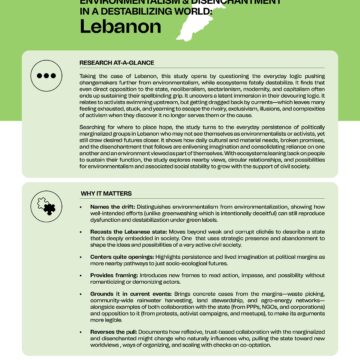
This study interrogates environmentalism as a concept and contemporary practice in Lebanon by tracing how actors are positioned in relation to the Lebanese state when navigating changemaking, abandonment, and the imperative of persistence. It understands environmentalism as emerging from socio‑ecological transformation and as fundamentally different from environmentalization, which arises from reproductions within the current order—namely today’s variations of neoliberal capitalism and the prevailing everyday mindset treating it as the most reasonable way to live.1Arturo Escobar, Encountering Development: The Making and Unmaking of the Third World, Princeton University Press, 2011. Lebanon’s current order is organized around a sectarian form of aggressive neoliberal capitalism—marked by puzzling tendencies such as championing free markets while selectively shaping them to serve entrenched power.2Karim Makdisi, “Lebanon’s October 2019 Uprising: From Solidarity to Division and Descent into the Known Unknown”, South Atlantic Quarterly, Vol. 120 No. 2, 2021 [Makdisi, 2021]; Kamal Dib, “Predator Neoliberalism”, Contemporary Arab Affairs, Vol. 13 No. 1, 2020 [Dib, 2021]. The study highlights how prefigurative politics—the enactment of desired futures by meeting everyday material needs for persistence—is emerging from Lebanon’s political margins3Political margins are understood as areas and groups historically deprived of influence over how power is organized or exercised. Steven Lukes, “Power: A Radical View”, Palgrave Macmillan, 2005. and can give way to environmentalism.4David Schlosberg and Luke Craven. “Sustainable Materialism”, Oxford University Press, 2019 [Schlosberg & Craven, 2019]; Munira Khayyat, A Landscape of War: Ecologies of Resistance and Survival in South Lebanon, University of California Press, 2022 [Khayyat, 2022].
Even the most marginalized visions and practices trace back to broader entanglements—between states, current orders, and global environmental change. A systems perspective helps place what is happening in Lebanon within processes of reproduction through environmentalization or transformation from environmentalism. With the consolidation of power, states engage in feedback loops5A feedback loop is an active process where the outputs of a system circle back and are used as inputs, forming a complex chain of cause and effect that influences the system’s future behavior. Marco Scotti, Daniel Filipe Da Silva Pereira, and Antonio Bodini, “Understanding Social-Ecological Systems Using Loop Analysis”, Human Ecology Review, Vol. 26 No. 2, 2020 [Da Silva et al., 2020]. with the current order they govern. Ultimately, these feedback loops either reproduce the current order or, at times, drive it toward fundamentally different configurations—all of which unfold within, and affect, the enabling and constraining parameters of the biophysical Earth system (i.e., the environment).6John S. Dryzek, “The Politics of the Earth”, Oxford University Press, 2021 [Dryzek, 2021]; Da Silva et al., 2020; Belinda Reyers et al., “Social-Ecological Systems Insights for Navigating the Dynamics of the Anthropocene”, Annual Review of Environment and Resources, Vol. 43 No. 1, 2018; Ulrich Brand, “How to Get Out of the Multiple Crisis? Contours of a Critical Theory of Social-Ecological Transformation”, Environmental Values, Vol. 25 No. 5, 2016. A specific current order, its surrounding environment, and the relationship between them (i.e., a socio-ecological system) can be studied at any geographic scale—regions, nation-states, and municipal communities being the most common—even though scales are fundamentally intertwined and constitute a global current order, environment, and socio-ecological system.7Katherine Richardson et al., “Earth Beyond Six of Nine Planetary Boundaries”, Science Advances, Vol. 9 No. 37, 2023 [Richardson et al., 2023]; John W. Meyer et al., “World Society and the Nation-State”, American Journal of Sociology, Vol. 103 No. 1, 1997 [Meyer et al., 1997]. Scalar boundaries are, of course, not inherent but reflective of the user’s purpose and perspective.8Sallie A. Marston, John Paul Jones II, & Keith Woodward, “Human Geography without Scale”, Transactions of the Institute of British Geographers, Vol. 30 No. 4, 2005; Roderick P. Neumann, “Political Ecology: Theorizing Scale”, Progress in Human Geography, Vol. 33 No. 3, 2009.
Beyond the selection of scales, today’s purpose, perspective, and socio-ecological systems are primarily immersed in neoliberal capitalism. It presumes that natural resources are limitless or can be endlessly substituted and that, through technological innovation and manipulated market mechanisms posing as free, we will solve whatever the Earth system throws at us, keeping neoliberal capitalist structures intact and societies civilized.9Jeanne M. Bogert et al., “Reviewing the Relationship Between Neoliberal Societies and Nature: Implications of the Industrialized Dominant Social Paradigm for a Sustainable Future”, Ecology and Society, Vol. 27 No. 2, 2022. The best available evidence challenges the logic of this global experiment—as scientists warn we have little margin for trial and error with a system that repeatedly demonstrates its inability to maintain planetary stability.10Nico Wunderling et al., “Climate Tipping Point Interactions and Cascades: A Review”, Earth System Dynamics, Vol. 15 No. 1, 2024; Michael A. Long et al., “Neoliberalism, World-System Position, and Biodiversity Loss”, Sociology of Development, Vol. 10 No. 3, 2024; Richardson et al., 2023; Johan Rockström et al., “Safe and Just Earth System Boundaries”, Nature, Vol. 619 No. 7968, 2023 [Rockström et al., 2023]. Nonetheless, as planetary destabilization (e.g., climate change, biodiversity collapse, and chemical pollution) becomes increasingly evident and directly experienced, policies, business models, institutions, armed forces, tourism destinations, show business, and a wide range of other domains and actors are engaging in environmentalization: a process of selectively using environmental evidence and critiques to construct identities and actions that ultimately reproduce neoliberal capitalism and one’s role within it.11David Ciplet and J. Timmons Roberts, “Climate Change and the Transition to Neoliberal Environmental Governance”, Global Environmental Change, Vol. 46, September 2017; Bram Büscher et al., “Nature Inc.: Environmental Conservation in the Neoliberal Age”, University of Arizona Press, 2019; Adrian Parr, “The Wrath of Capital: Neoliberalism and Climate Change Politics”, Columbia University Press, 2013.
On the other hand, planetary destabilization is engendering scholarship and practice around socio-ecological transformation, focusing on alternative futures.12Christoph Görg et al., “Challenges for Social-Ecological Transformations: Contributions From Social and Political Ecology”, Sustainability, Vol. 9 No. 7, 2017; Viviana Asara et al., “Socially Sustainable Degrowth as a Social-ecological Transformation: Repoliticizing Sustainability”, Sustainability Science, Vol. 10 No. 3, 2015; Michele-Lee Moore et al., “Studying the Complexity of Change: Toward an Analytical Framework for Understanding Deliberate Social-ecological Transformations”, Ecology and Society, Vol. 19 No. 4, 2014. Environmentalism is understood as diverse actions and processes that, regardless of their identifiers and foundations, create immediate and long-term socio-ecological transformations that could bring us within all nine life-supporting planetary boundaries.13Beyond climate, biodiversity, and pollution, the planetary boundary framework gives us a useful tool to conceptualize and quantify, in more totality, nine Earth system processes that enable a “safe operating space for humanity.” It helps avoid the widespread dilemma of environmental trade-offs—where addressing one challenge can exacerbate another—by offering an integrated view of the Earth system. Richardson et al., 2023. Given the complexity, it remains uncertain which alternative social-ecological arrangements would steer the Earth system toward a safe operating space for civilization. Yet there is an actionable level of scientific consensus—grounded in biophysical thresholds—and a convergence of marginalized voices—rooted in lived experience and systemic abandonment—that, in Elizabeth Povinelli’s terms, share the belief that it is “not this” current order.14Elizabeth A. Povinelli, “Economies of Abandonment: Social Belonging and Endurance in Late Liberalism”, Duke University Press, 2011 [Povinelli, 2011]. That stance unsettles the rush for quick solutions that reproduce familiar harms and highlights the work of quiet persistence: slow, deliberate effort to stay present and leverage what is available, while refusing to let ideas about the current order harden into the only possible future.15Povinelli, 2011. This is not a revolutionary, anarchist, or sovereign Indigenous “no” to what the current order offers; it is an occupation of the open space between disenchantment and replacement.16Povinelli, 2011. Far from signaling absence, persisting in the in-between can give rise to imagination that challenges prevailing mindsets—i.e., it provides room for new, more autonomous and relevant imaginaries17Imaginaries are understood as visions of desirable futures, shaped by shared understandings of what kinds of social life and social order are attainable. Adapted from Sheila Jasanoff and Sang-Hyun Kim, “Dreamscapes of Modernity: Sociotechnical Imaginaries and the Fabrication of Power”, University of Chicago Press, 2015. to breathe.18Dryzek, 2021; Marit Hammond, “Imagination and Critique in Environmental Politics”, Routledge, 2022. These imaginaries animate prefigurative politics, giving direction and meaning to efforts that can make alternative futures real.19Schlosberg & Craven, 2019; Dryzek, 2021
In stark contrast, environmentalization—unlike the deceptive misrepresentations typical of greenwashing—produces efforts that are likely genuine in intention, yet anxious, awkward, and constrained in their application, as they attempt to articulate a beneficial relationship to a destabilizing environment in deliberate or incidental alignment with the very order that is driving it. This process signals an inability or unwillingness to engage in the ontological and political questioning that environmentalism demands. Environmentalization often relies on dissociation and reality-splitting—used to preserve the logic of reinforcing the current order while attempting to care for the environment—or on an underappreciation of socio-ecological systems.
In this context, the role of the state comes into focus, given that in changemaking ecosystems, states are treated as the primary referent for shaping environmental conditions and determining what forms of action are considered relevant and acceptable.20Hanne Svarstad et al., “Power Theories in Political Ecology”, Journal of Political Ecology, Vol. 25 No. 1, 2018; Begoña Aretxaga, “Maddening States”, Annual Review of Anthropology, Vol. 32 No. 1, 2003 [Aretxaga, 2003]. The more actors center the state, the more its prosaic logic—i.e., its administrative rationale, economic rationale, and democratic pragmatism21Administrative rationalism relies on traditional experts and bureaucracy, depoliticizing issues and masking power imbalances. Economic rationalism uses market mechanisms, reducing complex socio-ecological processes to monetary terms. Democratic pragmatism emphasizes public participation and consensus but persistently yields incremental, watered-down solutions that do not disrupt entrenched power imbalances and interests. These terms are adapted from Dryzek (2021). —is likely to shape how they act and condition what they consider normal and possible.22Dryzek, 2021; Aretxaga, 2003. Centering the state during changemaking can, whether deliberately or incidentally, reproduce the current order. However, literature highlights the potential of politically marginalized actors—who shoulder the brunt of planetary destabilization and interlinked social precarity—to imagine and enact alternative sociopolitical organizing toward environmentalism.23Elia Apostolopoulou et al., “Radical Social Innovations and the Spatialities of Grassroots Activism: Navigating Pathways for Tackling Inequality and Reinventing the Commons”, Journal of Political Ecology, Vol. 29 No. 1, 2022. [Apostolopoulou et al., 2022]; Dana Léo-Paul et al., “Success Factors and Challenges of Grassroots Innovations: Learning from Failure”, Technological Forecasting and Social Change, 164, 2021; Arnim Scheidel et al., “Environmental Conflicts and Defenders: A Global Overview”, Global Environmental Change, Vol. 63, 2020; Leah Temper et al., “A Perspective on Radical Transformations to Sustainability: Resistances, Movements and Alternatives”, Sustainability Science, Vol. 13 No. 3, 2018 [Temper et al., 2018]; Frans Hermans et al., “Scale Dynamics of Grassroots Innovations through Parallel Pathways of Transformative Change”, Ecological Economics, 130, 2016 [Hermans et al., 2016]. Their persistence—understood as efforts to meet everyday material needs and desires while expressing cultural life through relations with the surrounding environment—evolves to resist displacement and other forms of loss. Persistence positions the marginalized between disenchantment—with the state and the current order it upholds, when necessary and possible, even though their presence is already limited at the margins—and the imperative of living out a replacement.24Iokiñe Rodríguez, “Just Transformations : Grassroots Struggles for Alternative Futures”, Pluto Press, 2023; Amanda Machin, “Climates of Democracy: Skeptical, Rational, and Radical Imaginaries”, Wiley Interdisciplinary Reviews Climate Change, Vol. 13 No. 4, 2022; Farhana Sultana, “Political Ecology II: Conjunctures, Crises, and Critical Publics”, Progress in Human Geography, Vol. 45 No. 6, 2021; Temper et al., 2018; Povinelli, 2011. More than coping, it can be thought of as the quiet practice of world-making.
Using political ecology and economy as a lens, the study focuses on two lines of inquiry, taking Lebanon as a case study:
- How does deliberate and incidental environmentalization emerge from centering the Lebanese state?
- At the margins, when and how does disenchantment with the current order make space for prefigurative politics toward environmentalism?
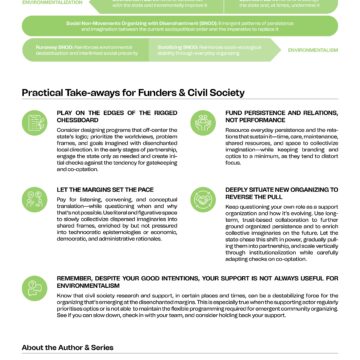
To address these questions, I propose a conceptual framework contrasting state-bent hypothetical actions (SBHA), which translates to “swimming” in Arabic, and social non-movements organizing with disenchantment (SNOD), which translates to “lean” in Arabic.25The significance of this Arabic nomenclature will be further explored later, as it serves as a symbolic reflection of the ways these dynamics unfold. ‘SBHA’ implies submersion in the state’s prosaic logic, irrespective of whether an actor is for or against the state or the current order it reinforces. When submersed, swimming becomes imperative, and the movement symbolizes the perpetual enactment of changemaking hypotheses (i.e., initiatives with theories of change that use causal logic to pursue desired outcomes). ‘SNOD’ refers to an emergent pattern of leaning on each other and the environment—and the environment and others leaning back—to enable the mutual persistence of all.26Khayyat, 2022 Persistence through this circular leaning, or interdependence, breaks causal superiority (i.e., this leads to that) and undermines the relevance of the state and its prosaic logic.
The framework helps surface perspectives and examples of paradox, decision-making impasse, crisis-making, and complications that often accompany state-oriented environmental action in Lebanon. I do not consider these outcomes inherent to action concerning the state, but rather common and persistent within Lebanon’s contemporary realities—which are, of course, subject to change. I find that, in the interest of clarity, time, and collective action in addressing destabilization and precarity, there is reason to focus more on SNOD. Through the lens of the framework, I use case studies of persistence at the margins to explore how SNOD is engendering prefigurative politics toward environmentalism.27Schlosberg & Craven, 2019; Khayyat, 2022. I organize the cases progressively, from those with the least to the most generative potential for such sociopolitical organizing. Rather than trying to offer a blueprint for environmentalism—which may, in any case, be unfathomable—I trace possibilities, at least for the cooperative and imaginative work it calls for. Case studies focus on waste pickers concentrated in urban centers who collect more plastics than the combined total of Lebanon’s municipalities28Laila Duisenova, “The Vulnerabilities of Informal Waste Pickers: A Critical Issue in Lebanon’s Waste Sector”, ReFuse, 2024, [Duisenova, 2024]; Sammy Kayed and Pedro Fernandez, “Baseline situation for selected single use plastic items in Lebanon”, WES Program, 2023, [Kayed & Fernandez, 2023]. ; rainwater harvesting in Dannieh providing a backbone for local life; agro-food barter networks and solar proliferation at the foothills of Jabal el Sheikh, where armed conflict is persistent; and lastly wildfire and land management partnerships in Akkar. I end with an invitation for civil society actors concerned with governance and sustainability transformations to consider the role of SNOD actors and the spaces they inhabit when envisioning futures, framing problems, and engaging in changemaking.
Endnotes
| ↑1 | Arturo Escobar, Encountering Development: The Making and Unmaking of the Third World, Princeton University Press, 2011. |
|---|---|
| ↑2 | Karim Makdisi, “Lebanon’s October 2019 Uprising: From Solidarity to Division and Descent into the Known Unknown”, South Atlantic Quarterly, Vol. 120 No. 2, 2021 [Makdisi, 2021]; Kamal Dib, “Predator Neoliberalism”, Contemporary Arab Affairs, Vol. 13 No. 1, 2020 [Dib, 2021]. |
| ↑3 | Political margins are understood as areas and groups historically deprived of influence over how power is organized or exercised. Steven Lukes, “Power: A Radical View”, Palgrave Macmillan, 2005. |
| ↑4 | David Schlosberg and Luke Craven. “Sustainable Materialism”, Oxford University Press, 2019 [Schlosberg & Craven, 2019]; Munira Khayyat, A Landscape of War: Ecologies of Resistance and Survival in South Lebanon, University of California Press, 2022 [Khayyat, 2022]. |
| ↑5 | A feedback loop is an active process where the outputs of a system circle back and are used as inputs, forming a complex chain of cause and effect that influences the system’s future behavior. Marco Scotti, Daniel Filipe Da Silva Pereira, and Antonio Bodini, “Understanding Social-Ecological Systems Using Loop Analysis”, Human Ecology Review, Vol. 26 No. 2, 2020 [Da Silva et al., 2020]. |
| ↑6 | John S. Dryzek, “The Politics of the Earth”, Oxford University Press, 2021 [Dryzek, 2021]; Da Silva et al., 2020; Belinda Reyers et al., “Social-Ecological Systems Insights for Navigating the Dynamics of the Anthropocene”, Annual Review of Environment and Resources, Vol. 43 No. 1, 2018; Ulrich Brand, “How to Get Out of the Multiple Crisis? Contours of a Critical Theory of Social-Ecological Transformation”, Environmental Values, Vol. 25 No. 5, 2016. |
| ↑7 | Katherine Richardson et al., “Earth Beyond Six of Nine Planetary Boundaries”, Science Advances, Vol. 9 No. 37, 2023 [Richardson et al., 2023]; John W. Meyer et al., “World Society and the Nation-State”, American Journal of Sociology, Vol. 103 No. 1, 1997 [Meyer et al., 1997]. |
| ↑8 | Sallie A. Marston, John Paul Jones II, & Keith Woodward, “Human Geography without Scale”, Transactions of the Institute of British Geographers, Vol. 30 No. 4, 2005; Roderick P. Neumann, “Political Ecology: Theorizing Scale”, Progress in Human Geography, Vol. 33 No. 3, 2009. |
| ↑9 | Jeanne M. Bogert et al., “Reviewing the Relationship Between Neoliberal Societies and Nature: Implications of the Industrialized Dominant Social Paradigm for a Sustainable Future”, Ecology and Society, Vol. 27 No. 2, 2022. |
| ↑10 | Nico Wunderling et al., “Climate Tipping Point Interactions and Cascades: A Review”, Earth System Dynamics, Vol. 15 No. 1, 2024; Michael A. Long et al., “Neoliberalism, World-System Position, and Biodiversity Loss”, Sociology of Development, Vol. 10 No. 3, 2024; Richardson et al., 2023; Johan Rockström et al., “Safe and Just Earth System Boundaries”, Nature, Vol. 619 No. 7968, 2023 [Rockström et al., 2023]. |
| ↑11 | David Ciplet and J. Timmons Roberts, “Climate Change and the Transition to Neoliberal Environmental Governance”, Global Environmental Change, Vol. 46, September 2017; Bram Büscher et al., “Nature Inc.: Environmental Conservation in the Neoliberal Age”, University of Arizona Press, 2019; Adrian Parr, “The Wrath of Capital: Neoliberalism and Climate Change Politics”, Columbia University Press, 2013. |
| ↑12 | Christoph Görg et al., “Challenges for Social-Ecological Transformations: Contributions From Social and Political Ecology”, Sustainability, Vol. 9 No. 7, 2017; Viviana Asara et al., “Socially Sustainable Degrowth as a Social-ecological Transformation: Repoliticizing Sustainability”, Sustainability Science, Vol. 10 No. 3, 2015; Michele-Lee Moore et al., “Studying the Complexity of Change: Toward an Analytical Framework for Understanding Deliberate Social-ecological Transformations”, Ecology and Society, Vol. 19 No. 4, 2014. |
| ↑13 | Beyond climate, biodiversity, and pollution, the planetary boundary framework gives us a useful tool to conceptualize and quantify, in more totality, nine Earth system processes that enable a “safe operating space for humanity.” It helps avoid the widespread dilemma of environmental trade-offs—where addressing one challenge can exacerbate another—by offering an integrated view of the Earth system. Richardson et al., 2023. |
| ↑14 | Elizabeth A. Povinelli, “Economies of Abandonment: Social Belonging and Endurance in Late Liberalism”, Duke University Press, 2011 [Povinelli, 2011]. |
| ↑15 | Povinelli, 2011. |
| ↑16 | Povinelli, 2011. |
| ↑17 | Imaginaries are understood as visions of desirable futures, shaped by shared understandings of what kinds of social life and social order are attainable. Adapted from Sheila Jasanoff and Sang-Hyun Kim, “Dreamscapes of Modernity: Sociotechnical Imaginaries and the Fabrication of Power”, University of Chicago Press, 2015. |
| ↑18 | Dryzek, 2021; Marit Hammond, “Imagination and Critique in Environmental Politics”, Routledge, 2022. |
| ↑19 | Schlosberg & Craven, 2019; Dryzek, 2021 |
| ↑20 | Hanne Svarstad et al., “Power Theories in Political Ecology”, Journal of Political Ecology, Vol. 25 No. 1, 2018; Begoña Aretxaga, “Maddening States”, Annual Review of Anthropology, Vol. 32 No. 1, 2003 [Aretxaga, 2003]. |
| ↑21 | Administrative rationalism relies on traditional experts and bureaucracy, depoliticizing issues and masking power imbalances. Economic rationalism uses market mechanisms, reducing complex socio-ecological processes to monetary terms. Democratic pragmatism emphasizes public participation and consensus but persistently yields incremental, watered-down solutions that do not disrupt entrenched power imbalances and interests. These terms are adapted from Dryzek (2021). |
| ↑22 | Dryzek, 2021; Aretxaga, 2003. |
| ↑23 | Elia Apostolopoulou et al., “Radical Social Innovations and the Spatialities of Grassroots Activism: Navigating Pathways for Tackling Inequality and Reinventing the Commons”, Journal of Political Ecology, Vol. 29 No. 1, 2022. [Apostolopoulou et al., 2022]; Dana Léo-Paul et al., “Success Factors and Challenges of Grassroots Innovations: Learning from Failure”, Technological Forecasting and Social Change, 164, 2021; Arnim Scheidel et al., “Environmental Conflicts and Defenders: A Global Overview”, Global Environmental Change, Vol. 63, 2020; Leah Temper et al., “A Perspective on Radical Transformations to Sustainability: Resistances, Movements and Alternatives”, Sustainability Science, Vol. 13 No. 3, 2018 [Temper et al., 2018]; Frans Hermans et al., “Scale Dynamics of Grassroots Innovations through Parallel Pathways of Transformative Change”, Ecological Economics, 130, 2016 [Hermans et al., 2016]. |
| ↑24 | Iokiñe Rodríguez, “Just Transformations : Grassroots Struggles for Alternative Futures”, Pluto Press, 2023; Amanda Machin, “Climates of Democracy: Skeptical, Rational, and Radical Imaginaries”, Wiley Interdisciplinary Reviews Climate Change, Vol. 13 No. 4, 2022; Farhana Sultana, “Political Ecology II: Conjunctures, Crises, and Critical Publics”, Progress in Human Geography, Vol. 45 No. 6, 2021; Temper et al., 2018; Povinelli, 2011. |
| ↑25 | The significance of this Arabic nomenclature will be further explored later, as it serves as a symbolic reflection of the ways these dynamics unfold. |
| ↑26 | Khayyat, 2022 |
| ↑27 | Schlosberg & Craven, 2019; Khayyat, 2022. |
| ↑28 | Laila Duisenova, “The Vulnerabilities of Informal Waste Pickers: A Critical Issue in Lebanon’s Waste Sector”, ReFuse, 2024, [Duisenova, 2024]; Sammy Kayed and Pedro Fernandez, “Baseline situation for selected single use plastic items in Lebanon”, WES Program, 2023, [Kayed & Fernandez, 2023]. |