




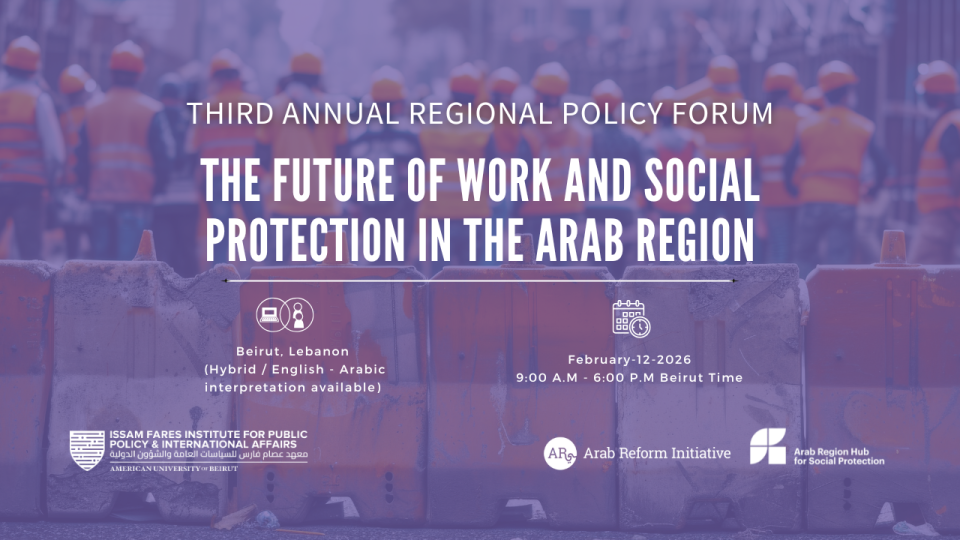
You can register to attend by following this link*. You will receive a Zoom confirmation email should your registration be successful. Alternatively, you can watch the event live here on our Facebook page.
* To attend technical sessions 2 and 4 online, please register using this link.
To attend in-person, please register using this link.
To download the agenda, click here.
This conference will take place at the Gefinor Rotana Hotel – Beirut
The world of work is undergoing profound and rapid transformations driven by global trends such as the green transition and de-carbonization, digitalization and the expansion of the digital economy, and the continued implementation of neoliberal economic policies – all of which are interconnected. In the Arab region, these trends are interacting with pre-existing vulnerabilities, conflict and fragility, and structural imbalances, leading to labor market shifts, eroding social protection systems, and deepening multidimensional inequalities. These shifts are evident in how jobs are being created, lost, displaced, and redefined; in the widening gap between high- and low-skilled workers; and in the rising informality and precarity of employment. They are therefore shaping the contours of access to social protection by affecting its financing, adequacy, coverage, and sustainability.
The most affected are vulnerable and marginalized social groups, including those characterized by lower skills, poor education, mobility difficulties, and less access to jobs, telecom infrastructure and technology because of digital divides. People facing additional barriers to entering the labor market and those traditionally excluded from formal social protections are likewise disproportionately affected. The livelihoods and wellbeing of informal and precarious workers, rural populations, youth and older persons, segments of women and LGBTQ+ communities, migrants, refugees, displaced persons, and people with disabilities are therefore put at stake. As transitions unfold, these social groups, which largely intersect, risk falling further behind unless reforms ensure that social protection systems are universal, adaptable, and effective.
In this context, the Arab Reform Initiative (ARI)’s Social Protection Program (SPP), this year in partnership with the Issam Fares Institute for Public Policy and International Affairs (IFI) at the American University of Beirut (AUB), is organizing its third Annual Regional Policy Forum to unpack the implications of the Future of Work (FoW) for social protection systems and subsequently vulnerable populations in the Arab region. The Forum will explore the policy reforms needed to safeguard social security and decent work in light of the three major and interacting drivers of change – the green transition, digitalization, and neoliberalism – while examining how they interact with structural issues like conflict, displacement, and fragility. It will offer a space to reflect on successful international experiences that could help find tangible and feasible solutions and guide national strategies.
The Forum will bring together researchers, practitioners, policymakers, and activists to assess emerging trends, share lessons learned, and collectively envision a rights-based and inclusive approach to work and social protection in the region. The needs of vulnerable groups will be central, and discussions will feature the latest research findings from ARI, partners of the SPP’s Arab Region Hub for Social Protection, members of the Global Campaign for the Right to Social Security, as well as independent civil society actors at large.
Speakers:
- Farah Al Shami, Senior Fellow and Social Protection Program Director – ARI
- Samir Nassar, Project Manager – Issam Fares Institute for Public Policy and International Affairs at AUB
- Ibrahim El-Badawi, Managing Director – Development Studies & Research Forum (DSRF)
- Ishac Diwan, Professor of the Practice of Economics – AUB
- Amena Sharaf, Independent Researcher and Programs Director Egyptian Foundation for Environmental Rights
- Diala Ahwach, Program Coordinator on Human Rights and Social Justice – ARI
- Dina Najjar, Senior Gender Scientist – ICARDA
- Shady ElBassouni, Associate Professor of Computer Science – AUB
- Lena Simet, Senior Researcher and Advocate, Poverty and Inequality – HRW
- Hania Sholkamy, Associate Professor of Sociology and Anthropology – AUC
- Rachel Sabates-Wheeler, Professor and Development Economist – Institute of Development Studies
- Zina Nimeh, Associate Professor of Public Policy and Social Protection/ Head of Education – UNU-MERIT/Maastricht University
- Ibtesam Al-Atiyat, Associate Professor of Sociology – St. Olaf College
- Mohamed El-Agati, Researcher & Director – Arab Forum for Alternatives
- Markus Loewe, Research Team Leader – IDOS
- Paul Makdissi, Professor of Economics – University of Ottawa
- Anis Ben Brik, Associate Professor of Public Policy – Hamad Bin Khalifa University
- Rana Jawad, Professor of Global Social Policy – University of Birmingham
- Rachel Forrester-Jones, Professor and Director of School of Health Studies, Western University
- Ahmad Awad, Founder and Director – Phenix Center for Economics & Informatics Studies
- Sylvana Lakkis, Co-founder and Chairperson – Arab Forum for the Rights of Persons with Disabilities
- Sabina Diwan, Founder and Executive Director – JustJobs Network
Moderator:
- Sarine Karajerjian, Environmental Politics Program Director – ARI
- Samir Nassar, Project Manager – Issam Fares Institute for Public Policy and International Affairs at AUB
- Nizar Ben Salah, Professor and Former Union Secretary General – University of Tunis
- Ghassan Al-Daoud, Program and Research Assistant – ARI
- Ali Abboud, Assistant Professor of Economics – AUB
- Salma Hussein, Lead Economist on Social and Fiscal Justice – Egyptian Initiative for Personal Rights
- Farah Al Shami, Senior Fellow and Social Protection Program Director – ARI