






In recent decades, Tunisia has undergone profound changes, affecting all sectors of agriculture, from production methods to seed supply systems to the relationship between farmers and the land itself.1Reports on Plant Genetic Resources Conservation 2018–2023, Institut National de la Recherche Agronomique de Tunisie (INRAT), http://www.inrat.agrinet.tn/index.php/en/ Since the late 1960s, agricultural policies have shifted towards an intensive production model based on high-yield hybrid seeds, relying heavily on chemical fertilizers and pesticides. This model has been associated globally with the so-called green revolution. However, this shift was not merely a technical modernization or an agricultural development method, but rather a turning point that changed the essence of the relationship between Tunisian farmers and the land, climate, and seeds, opening the door to new forms of dependence on global companies that now control agricultural supply chains.2Kacem Chammakhi and Mohamed Ali Dridi, “Actual Seed Situation in Tunisia: Agronomics Crops and Vegetables”, available at http://q.datakultur.se/~svalofco/wp-content/uploads/2012/12/Tunisia-Seed-Sector-Status-Paper.pdf
With the introduction of structural reform programs and market liberalization in the 1980s, these transformations accelerated. Under pressure from donors and under the banner of “agricultural modernization”, the state allowed global companies to enter the Tunisian market by force, marketing hybrid varieties linked to a costly production system dependent on imported inputs. At the same time, public investment in local varieties dropped,3Ben Othman, “Agricultural Heritage and Local Knowledge in Tunisia”, University of Tunis, 2017. leading to a decline in the amount of land devoted to local seeds, which, until recently, had been the basis of food security for rural communities. This process culminated with the adoption of Law No. 99-42 of 10 May 1999, on seeds, seedlings, and plant propagules. The law imposed a strict registration system for plant varieties, linked marketing to technical standards that did not take into account local specificities, and granted legal protection rights to breeders. These factors pushed native seeds to the margins, gradually removing them from the legal sphere. The official discourse presented hybrid seeds as the optimal scientific solution to the problem of low production,4World Bank, “Tunisia: Agricultural Sector Adjustment Loan II (Ln. 3078-TUN)”, 1995 https://tinyurl.com/3yeenbfc which encouraged their widespread use, especially in grain production.
However, this shift did not go unchallenged. Beyond official discourse and legal documents, silent resistance emerged in various forms, restoring seeds to their original role as bearers of sovereignty and a resource that cannot be reduced to market logic or constrained by laws written in offices far from the land.
Silent Resistance to Preserve Native Seeds
Tunisian farmers developed forms of silent resistance to the law of 10 May 1999, which regulated the registration and circulation of seeds. Instead of complying fully with it, they continued to produce their local seeds based on their inherited expertise, believing that their agricultural and symbolic value exceeded that of commercial varieties. This allowed them to circumvent legal restrictions without directly confronting the state. Such practices represent a means of protecting native seeds, and this resistance reflects the farmers’ ability to reinterpret the law in accordance with their agricultural traditions and to invest their social capital in confronting the legal and economic hegemony imposed on them.
The Tunisian farmers’ resistance to hybrid seeds was not driven merely by nostalgia but was based on deep agronomic knowledge and cultural, social, and economic motivations. Over time, most farmers found themselves trapped in a cycle of dependence on global markets. Hybrid seeds cannot be reused and must therefore be purchased every season, in addition to the constant need for chemical fertilizers and pesticides. This system has forced farmers to bear high costs, especially during dry seasons. As one farmer put it: “Hybrid seeds work for one season and lose you three seasons,” referring to the unbalanced economic cycle imposed by these seeds.
Tunisian farmers did not accept being stripped of their seeds, as seeds are not just a means of production for them, but part of the land’s memory and their inherited knowledge. With a ban on commercial exchange, cooperative methods emerged and gave these seeds new paths to life. One of the most important paths is the undeclared cooperation between farmers and the National Gene Bank. This national institution, responsible for preserving genetic heritage, does not own land on which to reproduce local varieties. To overcome this constraint, the bank relies on a network of farmers who agree to grow what it collects during field campaigns across various regions. Farmers receive a quantity of seeds to grow during the season. At the end of the cycle, they return an equivalent quantity to the bank, keeping any surplus for their use at no cost. As one farmer in the governorate of Kairouan explains: “We grow the seeds and return the deposit, and the rest is God’s provision.” This simple system ensures that the bank maintains the fertility of its seed stock and renews it periodically, while giving farmers partial legal access and direct benefit from the seed. At its core, this cooperation represents dual resistance: the institution protects genetic memory, and farmers protect their independence.
On another level, resistance takes shape in a collective social space: seed festivals organized by environmental and farming associations and organizations. Widespread across the northwest, center, and south, these gatherings are becoming unofficially recognized free markets for seeds. Farmers bring bags and small offerings of their local seeds, exchanging them in a festive atmosphere, without any declared sales or contracts. These exchanges here are not only economic but also symbolic – a collective declaration that seeds belong to everyone, and that the law cannot erase collective knowledge or stop centuries of living practice. At these festivals, seeds become social bonds and reclaim their value as a shared resource, rather than a commodity governed by international technical standards.
Farming Outside the System: A Shadow Economy that Protects Seeds
Resistance is not limited to institutions or regulatory spaces; rather, most of it grows within the informal economy that prevails in rural Tunisia. Despite successive attempts at “modernization” and the imposition of tracking and digitalization mechanisms, agriculture has remained beyond the state’s effective capacity for comprehensive regulation. Since independence, the state has been unable to integrate small farmers into a formal agricultural system that can be measured and monitored because agriculture is essentially based on flexible social networks that are difficult to control and grounded in a parallel economic logic that is not subject to taxes or production records. This “non-system” is not a loophole, but a deeply rooted economic structure that constitutes what many researchers call “the backbone of the real economy”,5Belarbi Abdelkader and Abdellaoui Mohammad Ibrahim, “The Informal Sector: The Backbone of the Algerian Economy” [Arabic], Les Cahiers du MECAS 7, no. 1 (2011) pp. 212–225, https://asjp.cerist.dz/en/article/9612 that is, an economy that continues to function when state institutions fail.
In this parallel space, local seeds move freely because the state itself has failed to build a system capable of monitoring them. When production chains are informal and transactions – whether buying, selling, and bartering – take place off the state’s books, the law is ill-equipped to impose its logic. Seeds are transferred from hand to hand through seasonal offerings, unrecorded bartering, or family networks that connect villages and regions. While the law requires each variety to be registered as a discrete economic unit, farmers operate within a system that does not recognize this logic. Here, you hear them say: “Farming isn’t written on paper… It’s written in the soil.”
Seeds are stored in homes, earthen warehouses, and barns, just as they always have been – no official process requires otherwise. The agricultural economy has remained untraceable: no invoices, no production permits, and no accurate data on the quantities planted or traded. This makes the circulation of local seed a natural feature of an economic system that remains “invisible” to the state, yet functions very effectively for farmers who depend on it. The state may see this as disorganization, but farmers see it as guaranteeing continuity. Thus, the informal economy becomes not only a space for survival but also one for political resistance because it keeps seeds outside the authority of corporations and international laws. The state’s inability to “frame” farming, to turn it into a formal system that is monitored from planting to sale, has created an environment that allows local seeds to survive. When the legal framework fails to penetrate the reality of daily production, informality becomes an incubator for biodiversity and a shield that protects agricultural heritage from extinction. Whether formal or parallel, seeds continue to circulate, carrying with them a sovereignty that neither the state nor corporations has been able to transform into controllable data.
Memory Sprouts Anew: Stories of Farmers with Native Seeds
The Tunisian farmers’ resistance is not merely a technical objection to a new production model, but a multi-layered struggle where the economy intersects with culture, and society with ecology. This resistance stems from a deep understanding that native seeds are not merely biological units but tools of sovereignty and a condition of agricultural independence. Through their daily experience, farmers have realized that abandoning local seeds means abandoning their decision-making power and their ability to control resources away from corporate monopolies and ruthless market conditions. Therefore, seed recovery has become an act of self-defense and a means of redefining the relationship between humans and the land outside the logic of dependency.
This awareness has made farmers’ daily experiences a source for reviving varieties that were on the verge of extinction and building a new vision of food sovereignty based on inherited knowledge and respect for the country’s environment and climate. Thus, resistance has proven that Tunisian farmers are not merely executors of state plans or donor roadmaps but social actors with deep-rooted experience and an ability to protect their agricultural heritage and sustain their land. These experiences today are one of the most important practical responses to Law 42-1999 and the commercial logic that seeks to turn seeds into exclusive property.
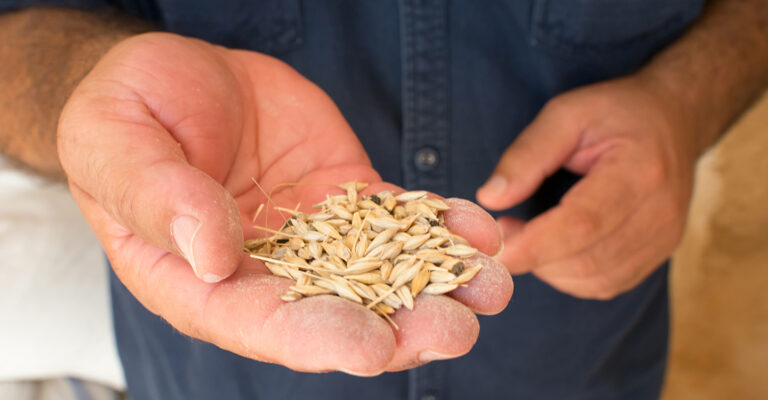
One of the most notable examples is the case of A.A. a local farmer in southern Tunisia, who has become a symbol of resistance to hybrid seeds. He has reintroduced more than 67 varieties of local wheat, some of which had disappeared decades ago, and has demonstrated, through his experience, that these varieties are resistant to drought and pests and are at least as productive as commercial varieties. He always says: “The land is the first school, and local seeds are its soul. The law may prevent you from selling, but the experience of our ancestors cannot be denied.” This sentence sums up an entire philosophy in the face of commodification: the land is a source of knowledge, and local seeds are a living extension of this inherited knowledge.
In the Monastir region, H.K. also stands out as an example of a farmer who has revived varieties that were on the verge of extinction. He focused on saving Taj al-Malik watermelon seeds and local barley varieties, distributing them free of charge to farmers, regardless of market logic or quick profits. In doing so, he has helped build a vast social network for preserving agricultural heritage, in which seeds are passed from hand to hand, just like stories and customs. “Every native seed we preserve is a message to our children: this is our identity, this is our land,” he says. It is a gentle form of resistance, but one that is powerful enough to break this cycle of extinction.
Following these experiences, it becomes clear that resistance cannot be understood without recognizing the deep symbolic dimension of native seeds. The true farmer does not see the seed as merely a means of production, but as part of the family history and collective memory of the countryside. Each local variety carries a story: a drought it survived, a woman who preserved its seeds in her attic, a man who carried it from one village to another. Planting local varieties is a form of honoring ancestors and part of what could be called “rural cultural capital”, which farming communities are keen to pass on without interruption.
With a rise in the discourse of food sovereignty in civil society, this cultural dimension has taken on a new political dimension. Preserving native seeds has become an act of resistance, demanding the return of control over agricultural resources, and linking local knowledge to environmental and social sustainability. When indigenous farmers plant seeds, they are not just performing a technical operation; they are making a quiet but firm statement: “We plant what we want… not what is imposed on us.”
Endnotes
| ↑1 | Reports on Plant Genetic Resources Conservation 2018–2023, Institut National de la Recherche Agronomique de Tunisie (INRAT), http://www.inrat.agrinet.tn/index.php/en/ |
|---|---|
| ↑2 | Kacem Chammakhi and Mohamed Ali Dridi, “Actual Seed Situation in Tunisia: Agronomics Crops and Vegetables”, available at http://q.datakultur.se/~svalofco/wp-content/uploads/2012/12/Tunisia-Seed-Sector-Status-Paper.pdf |
| ↑3 | Ben Othman, “Agricultural Heritage and Local Knowledge in Tunisia”, University of Tunis, 2017. |
| ↑4 | World Bank, “Tunisia: Agricultural Sector Adjustment Loan II (Ln. 3078-TUN)”, 1995 https://tinyurl.com/3yeenbfc |
| ↑5 | Belarbi Abdelkader and Abdellaoui Mohammad Ibrahim, “The Informal Sector: The Backbone of the Algerian Economy” [Arabic], Les Cahiers du MECAS 7, no. 1 (2011) pp. 212–225, https://asjp.cerist.dz/en/article/9612 |