






In many Muslim-majority societies, family laws grounded in religious interpretations continue to shape women’s lives, reinforcing inequality and limiting access to justice. Musawah, a global movement led by Muslim women, challenges these norms and advocates for reform. Through research, advocacy, and partnerships, Musawah seeks to reshape the discourse on Islam and gender toward transformative legal and social change. In this Q&A, the Arab Reform Initiative spoke to Musawah’s team, exploring the origins, strategies, and impact of the organization and discussing how it bridges feminist ethics and Islamic scholarship to advance equality and justice.
- What is Musawah, how did it start, and what inspired its creation and shaped its early vision?
‘Musawah’, which means ‘Equality’ in Arabic, is a global movement led by Muslim women working together to fight gender injustices and promote equality, justice, and compassion in laws, norms and social practices. Musawah engages with religion from a rights perspective, driven by feminist ethics and grounded in women’s lived realities across the world. Breaking down the dichotomies in the narratives of women’s rights, Musawah bridges the gaps between religion and women’s rights and marries scholarship and activism to build transformative knowledge, advocating for change at multiple levels.
At Musawah, we believe a rights-based understanding of Islam is critical to empower those who believe in equality and justice to stand up and argue for the possibility and necessity of legal reform. Our years of knowledge production have contributed to shifts in the discourse on Islam and women’s rights. We have brought together activists, policymakers, and religious scholars to end the use of Islam to justify legal and social discrimination against women, especially in the area of religious-based family laws and personal status laws and policies.
The seeds of our movement were planted by ‘Sisters in Islam’ (SIS), a women’s rights group advocating against discriminatory family laws and practices in Malaysia. In their work tracing the root causes of gender discrimination and stereotypes, they identified many common patterns in the lived experiences of Muslim women in other countries and continents. From Indonesia and Malaysia, to Jordan, Egypt, and Morocco, to Nigeria, Sudan, and Afghanistan, Islamic religious teachings, and ‘Shari‘ah’, were systematically built up as barriers to achieving gender equality. Advocates of this patriarchal discourse, which frames Islam and gender equality as irreconcilable, held authority over how the religion was understood and used as a source of law and practice. The pioneering work of Sisters in Islam broke this hegemony and opened up the public space for a rights-based discourse led by feminist Muslims that challenged long-held patriarchal understandings of Islam. Their work generated global interest.
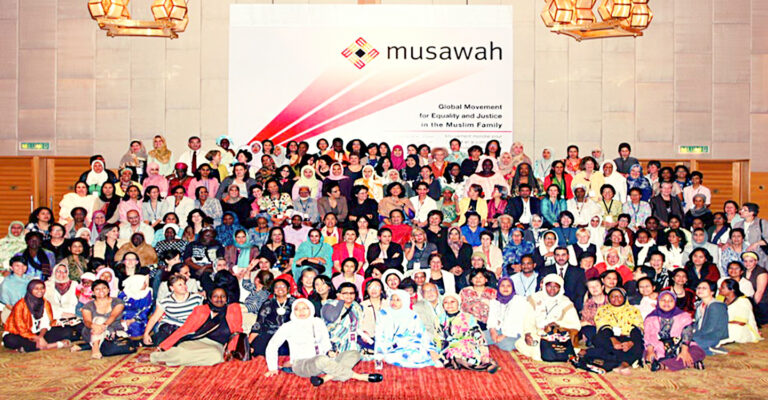
Sisters in Islam formed an international planning committee composed of activists and scholars from 10 countries – Egypt, Gambia, Indonesia, Iran, Malaysia, Morocco, Nigeria, Pakistan, Turkey, and the United Kingdom – to organize a global meeting on Muslim family laws and practices, which transformed into the need to create a sustainable movement beyond a single meeting. Musawah was launched in 2009, in a global meeting attended by more than 250 activists and scholars from 47 countries: a movement to demand equality and justice in the family, because the struggle for equality starts in our homes. Without equality in the private sphere of the family, there will be no equality in society.
Since 2009, Musawah has expanded with advocates across the world, empowering women with knowledge and courage to speak out publicly on the possibility and necessity of reform to discriminatory family laws and practices justified in the name of Islam. Over the years, Musawah has built a solid body of feminist scholarship and rights-based language that argues for reform towards equality and justice.
- How is Musawah structured as an organization, and why was this format/structure chosen?
Musawah is a global movement sustained by advocates from around the world. Its Secretariat leads the coordination and implementation of projects and activities, guided by our local partners and networks and based on the needs of local civil society. The organization’s structure is intentionally organic, flexible, and evolving. It is designed to support cross-regional collaboration and to advance Musawah’s mission of promoting equality and justice in the Muslim family, while adapting to the different contexts and needs.
- What role does Musawah play within the broader social movement of Islamic feminism, and what unique contributions does it bring to it?
The religious legitimation of patriarchy is one of the main challenges that confronts those fighting for gender equality in Muslim contexts. Musawah contends that to bring sustainable social change, we must develop arguments and strategies that can break the bond between patriarchy and authoritarian politics that sustain unjust laws and structures, whether they come in a religious or a secular guise.
Dominant knowledge, discourses, and narratives hold power. Reclaiming these spaces allows us to shape a political legitimacy based on our experience and our voices – which, ultimately, enables us to reclaim our power and achieve self-determination. Empowering women living in Muslim contexts to build and recognize their own expertise and legitimacy in dealing with religious interpretations is an essential part of challenging gender discrimination. This is what we have been doing – reclaiming access and the right to produce all forms of knowledge that affect change in Muslim families. Musawah has been questioning, resisting, and reclaiming this relationship between the production of knowledge and practices of power in Muslim contexts.
We bring a feminist and participatory approach to knowledge building, offering new perspectives on Islamic teachings by reinserting the lived realities of women, men, and children at the center of the production of religious knowledge, which ultimately informs and shapes laws, norms, and practices
- Who are Musawah’s key partners and collaborators? Why these partners, and how do these relationships strengthen your collective work?
Our partners span across Muslim contexts in the Middle East, Asia, and Africa. They include community leaders and local women’s rights organizations and activists. Musawah also engages with academics, jurists, and religious authorities to push forward reforms. These partnerships are based on the needs of local civil society actors and the opportunities for reform. This participatory and locally grounded approach ensures our work is collective, tailored, and relevant for different contexts. In this age of anti-rights forces advancing in local contexts, Musawah also identifies at-risk contexts to prevent further rollbacks on women’s rights.
- What tools are in Musawah’s toolkit? In other words, what activities do you undertake, and how do these connect to your objectives?
Over the years, Musawah’s knowledge-building body of work has contributed to shaping a religious discourse that embraces gender equality and supports transformative change on the ground, including the reform of family laws and practices. These resources provide organizations and advocates with the argumentation and knowledge needed in their reform efforts on the ground. Our capacity-building work also offers transformative learning experiences on Islam and gender that build the capacity and knowledge of activists to create change towards equality and justice in Muslim family laws and practices. Influencing public discourse is also a crucial element of our work. We work with artists, media, online influencers, and thought leaders to popularize proactive narratives and discourses on women’s rights in Islam with the aim of breaking the hegemony of conservative forces in religious discourse and show that reform of discriminatory law is possible. In the area of international advocacy, Musawah regularly submits thematic shadow reports on Article 16 of the Convention on the Elimination of All Forms of Discrimination Against Women (CEDAW) on marriage and family relations, the most reserved article of all treaty conventions. In these reports, we challenge the ways governments use Islam to justify their reservations and evade treaty obligations by providing language, legal concepts, and tools from the Muslim legal tradition that make reform possible. We also developed an evidence-based good practices guide on Muslim family laws, demonstrating that these so-called divine laws are indeed man-made and changeable.
- How do you work to make/influence change in national policies and legal frameworks at the country level? (For example, if you do not get involved in national politics at the local level, how does Musawah work with others that do?)
As a global entity, Musawah supports local partners and activists in their legal reform efforts. We see our role to provide knowledge, tools, and a platform for advocates, individuals and groups, that are involved in these local efforts to amplify their own campaigning initiatives. Musawah’s support to national family reform processes happens through capacity building and organizing and mobilizing mentorship behind the scenes. Our flagship Islam and Gender Equality and Justice (I-nGEJ) course has been critical in building the capacity of advocates to enable them to build their knowledge, skills, and courage to engage in a public debate on Islam and women’s rights and advocate for reform. Participants have used our trainings to effectively pursue legal and social changes and create impact in their communities. Our Thematic Reports to the CEDAW Committee are often prepared with national-level advocates, thus enabling their voices to be heard in Geneva, drawing attention to the sustained discrimination women face in the name of religion. The resultant Concluding Observations and Recommendations by the CEDAW Committee on Article 16 are crucial to enable advocates to put pressure on their governments to reform laws and practices that discriminate against women. It is obvious that these reservations and justifications for non-compliance are politically motivated, and the engagement of Musawah and its partners in the CEDAW sessions breaks the myth that these religion-based laws are divine laws that cannot be challenged or reformed.
- How do you understand the connection between knowledge production and policy change? How, concretely, do you leverage knowledge for policy change?
Musawah refuses to cede the space and the right to speak, from a religious perspective, on women’s rights. The movement makes the case for investing in the spaces of religious knowledge production, because this knowledge, this discourse, is already shaping our laws and practices, sustaining the privilege and interest of patriarchal forces. Musawah’s objective, therefore, is to insert women’s concerns and voices into the production of religious knowledge and legal reform in Muslim contexts.
This is why we offer a new knowledge-based discourse to advocate for change. Musawah’s entry point to women’s rights in the family was to work on the twin concepts of qiwamah and wilayah, which are commonly understood as having mandated men’s authority over women, and used to justify and institutionalize a patriarchal model of the family.
For example, in a multi-faceted research initiative (2010-2018), bringing together scholars, activists, and legal practitioners, Musawah traced the roots of male authority in Muslim legal tradition. Through the concept of qiwamah, jurists (fuqaha) derived a set of obligations and rights for women and men in marriage, based on the equation that husbands protect and provide, and in turn, women obey. Through the concept of wilayah, jurists derived a set of rules enabling fathers and male family members to exercise guardianship over dependent wards. Musawah explored the ways these two concepts were juridically constructed and reinforced to sustain male authority in Muslim households. These two fundamental concepts still inform many contemporary Muslim family laws and practices. For instance, the concept of marital obedience (ta’a) derived from qiwamah, is still at the core of many laws regulating marriage. The qiwamah-based system and its assumptions, about the myth of women’s inferiority, continue to be invoked to justify men’s privileged rights to divorce, polygamy, and greater inheritance shares. Musawah’s research1Mir-Hosseini, Ziba, Mulki Al-Sharmani and Jana Rumminger (eds). Men in Charge? Rethinking Authority in Muslim Legal Tradition. London: Oneworld, 2015. sheds light on the disconnect between the qiwamah-based system and the Qur’anic ethical worldview of family and women’s rights. We argue that qiwamah and wilayah as sanctions for male authority over women are not Qur’anic concepts but juristic constructs, and that laws based on these constructs no longer reflect the justice of Islam. We intend to promote other interpretations that are both possible and more in tune with contemporary lived realities.
Our knowledge-building work both challenges patriarchal interpretations and offers constructive visions for positive reforms in the family law and policy space. Our recommendations for reform of discriminatory legal systems have been used by universities, scholars, policy makers, and activists to support policy and legal reforms.
- What obstacles has Musawah faced? What are your priorities for the next decade?
We are experiencing a worldwide regression in women’s rights, and this is, of course, impacting advocacy efforts in the Middle East and North Africa, among other regions. Even in countries with positive developments in family law reform, such as Morocco, the gaps between the law provisions and their implementation on the ground are widening. Regressive trends have also been observed in many countries where family law reforms are rolled back due to political and socio-economic instability and conservative societal pressures. The most recent example is the setback on women’s rights in the Iraqi Personal Status Code. However, even when regression happens, adopting a holistic approach and engaging with religious sources is necessary to make a breakthrough and carve out space for women’s rights voices.
Therefore, in our experience, effective social change in family law reform requires the active collaboration of diverse actors – religious leaders, secular and rights-based advocates, feminists, state institutions, and community members – working together toward common goals. We recognized, however, that we cannot rely on legal reform strategies alone to fully address the socio-economic and cultural realities that shape gender inequalities, such as poverty, lack of education, and social stigmas. These limitations highlight the need for continued adaptation, stronger coalitions and solidarity among women’s rights groups, and broader societal engagement with different stakeholders to ensure that reforms translate into meaningful, long-term change.
This underscores the importance of a holistic, context-sensitive, and participatory approach –one that recognizes the complexity of changing lived realities and builds inclusive coalitions.
Not all answers are to be found in religious frameworks, but we cannot afford to ignore them because this is one of the spaces in which transformative and sustainable change can happen and needs to happen.
Endnotes
| ↑1 | Mir-Hosseini, Ziba, Mulki Al-Sharmani and Jana Rumminger (eds). Men in Charge? Rethinking Authority in Muslim Legal Tradition. London: Oneworld, 2015. |
|---|