








ARI’s Tech & Society Program explores how the accelerating deployment of technologies is affecting political life, economic activities, and the environment in MENA. Grounded in ARI’s approach which centers political participation and social justice, the program seeks to strengthen public scrutiny, democratic oversight, and civic participation in the deployment of these technologies. For us, the whole tech ecosystem – not just the end-user interfaces – needs to be scrutinized and debated in order to push for safer and more just societies as we move towards an ever-more digitized future.
By building an international community of practice and producing cutting-edge research, the program:
- Showcases the voices and experiences of local communities who experience first-hand the speed and breadth of technological advances;
- Centers social sciences and human impact in more technical discussions of technology in the region;
- Explores critical arenas to push for positive change;
- Examines how technologies interact with fragile governance systems and impact political participation; and
- Integrates a critical examination of technology in pursuit of ARI's broader objective of social and environmental justice.

Pillar 1: Tech, Political Participation, and Active Citizenship
The impact of technology on citizens’ political participation and their interaction with the state is extensive. Whether through online voting or digital registries to access key services, technology is drastically changing the way that citizens are interacting with their governments. These interactions are being fuelled through several mechanisms, such as farm bots and social media, with the aim of shifting narratives – one way or another – and exerting control over online spaces.
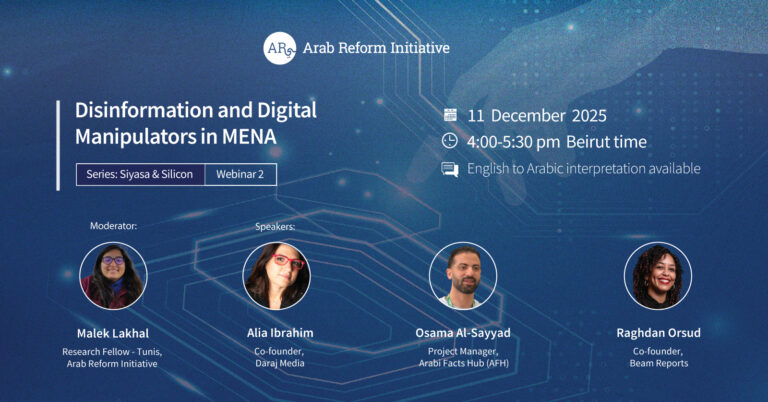
Under this pillar, ARI will continue its work to highlight disinformation for political gain and digital manipulators, citizen’s digital rights and access to information, and how tech is affecting power dynamics in the region.
Pillar 2: Digital Governance & Sovereignty
Countries in MENA are increasingly reliant on foreign technologies and external providers raising questions over sovereignty and control over key personal data. Meanwhile, some MENA countries, notably in the GCC, are aiming to improve their own digital infrastructure and governance policies in order to reduce reliance on external providers (especially those based in the US and the EU). There are several key aspects to this, including the physical infrastructure behind digital advancements; the nature of information that is available and disseminated; the ownership over data, its use, and its location; and the legal and governance frameworks that govern these aspects.
ARI is mapping and tracking the spread and development of physical and legal infrastructures and frameworks in the region, focusing in particular on questions of political economy, privacy, sovereignty, and accountability.
Pillar 3: Tech in Warfare & Surveillance
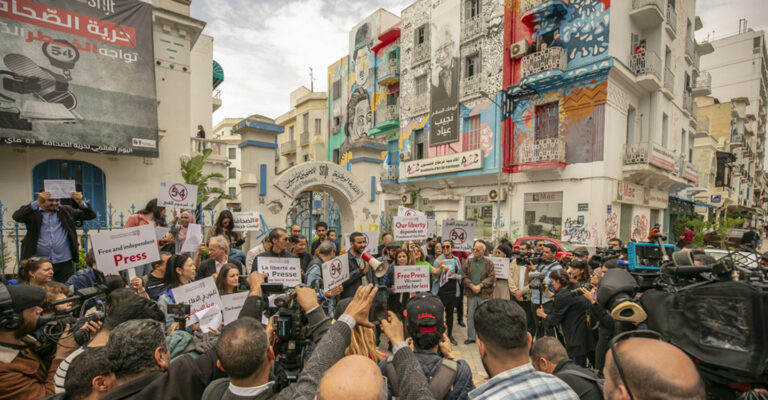
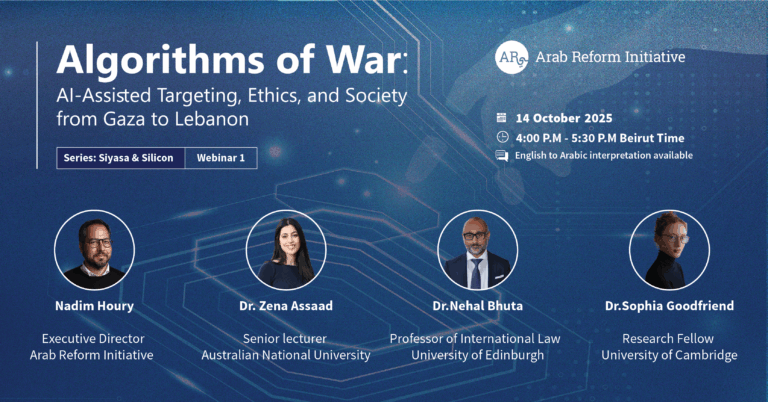
On the battlefield, AI-assisted targeting and predictive policing are transforming the ethics and accountability of warfare. In civic life, surveillance technologies and opaque algorithmic moderation practices restrict freedoms of expression, assembly, and association, often targeting journalists, activists, and marginalized communities.
In this pillar, we seek to open the black box of technology in militarization, especially through the lenses of accountability and legal frameworks; shed light on surveillance technologies, their uses, and their purposes; and document how censorship and (dis)information warfare are used in the region.
Publications

AI, Digitalization, and Social Protection in the Arab Region: A Human Development Conversation with Paul Makdissi

The Role of Media in Shaping Social Protection Narratives in the Arab Region

Cybercrime against Women in Yemen: Legal frameworks and social change

Tunisian Media: An Increasingly Curtailed Space for Debate

On the Egyptian State's Policy of Blocking Websites

Online Narratives and Manipulations: Tunisian and Regional Panorama

The Intersections of the Political and the Technical in the Design of Morocco's Social Targeting System

The Wilayah Haqqi Campaign: Egyptian Women's Rights in the Private and Public Spheres

AI in the national: AI Strategies of the Arab region

Technology and Collaboration: Successful against the odds and corruption in Lebanon?

Morocco: The Impact of the Digitization of Public Services

Demand-based Movements Under Authoritarianism: The Case of Egypt’s Unlimited Internet Campaign

Mediatized Arab diasporas: Understanding the role of transnational media in diasporic political action formation

Framing what's breaking: Empirical analysis of Al Jazeera and Al Arabiya Twitter coverage of the Gaza-Israel conflict

Data with borders for a borderless virus: Insights and recommendations from the case of Lebanon

Is the Worst Part Behind Us? Epidemiology, Data and Lebanon’s COVID-19 Response

Wikis as Catalysts for Activism: The Case of Arabic Wiki Gender

Policing the Digital Sphere: The Impact of Palestine’s Cybercrime Legislation

Access to Information in the Arab World: A Battle for Open Societies